
Entering a new market can create an important growth opportunity, but expansion is only attractive when a business can identify enough potential customers, reach them at a reasonable cost, and serve them profitably. A large population or fast-growing industry does not automatically translate into sales. Companies need to understand who is likely to buy, what those customers need, how much they may spend, and which alternatives already serve them.
Market sizing and opportunity analysis help business owners, founders, sales leaders, and marketing teams make this decision using evidence rather than assumptions. This guide explains how to define a market, calculate TAM, SAM, and SOM, find underserved customer groups, and decide whether a new market deserves investment.
Why Should Businesses Estimate Market Size Before Expanding?
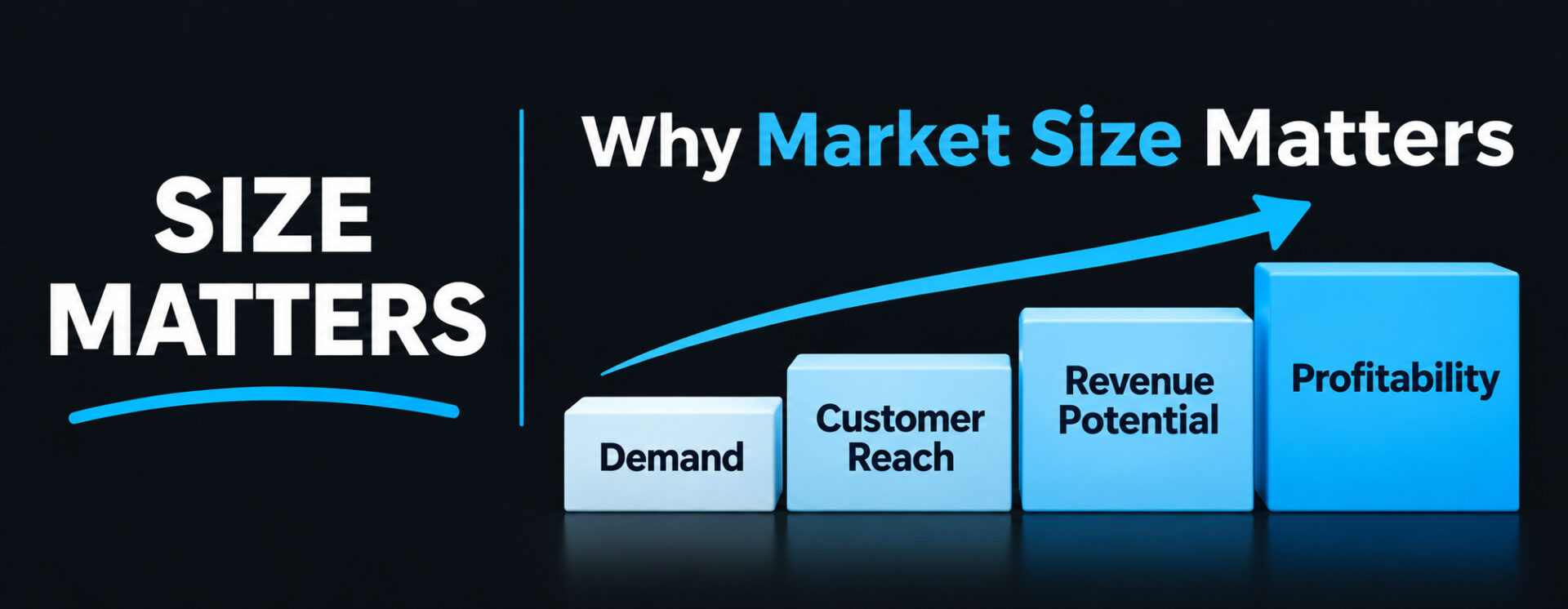
Market sizing estimates the potential customers and revenue within a defined market. It helps test whether the opportunity justifies entry costs and whether the product, pricing, and distribution model fit. The U.S. Small Business Administration recommends examining demand, market size, economic indicators, location, saturation, and competitor pricing in its market research guide.
Consider a workforce software company expanding from one state into another. A large business population does not show how many companies need the product, already use a competitor, or can afford it. The company must identify organizations that fit its offer, can be reached by its sales team, and have a reason to buy.
For a related discussion of defining an audience before outreach, see Jared’s Leads’ guide to building a B2B prospecting strategy.
Step 1: Define the Market You Actually Want to Enter
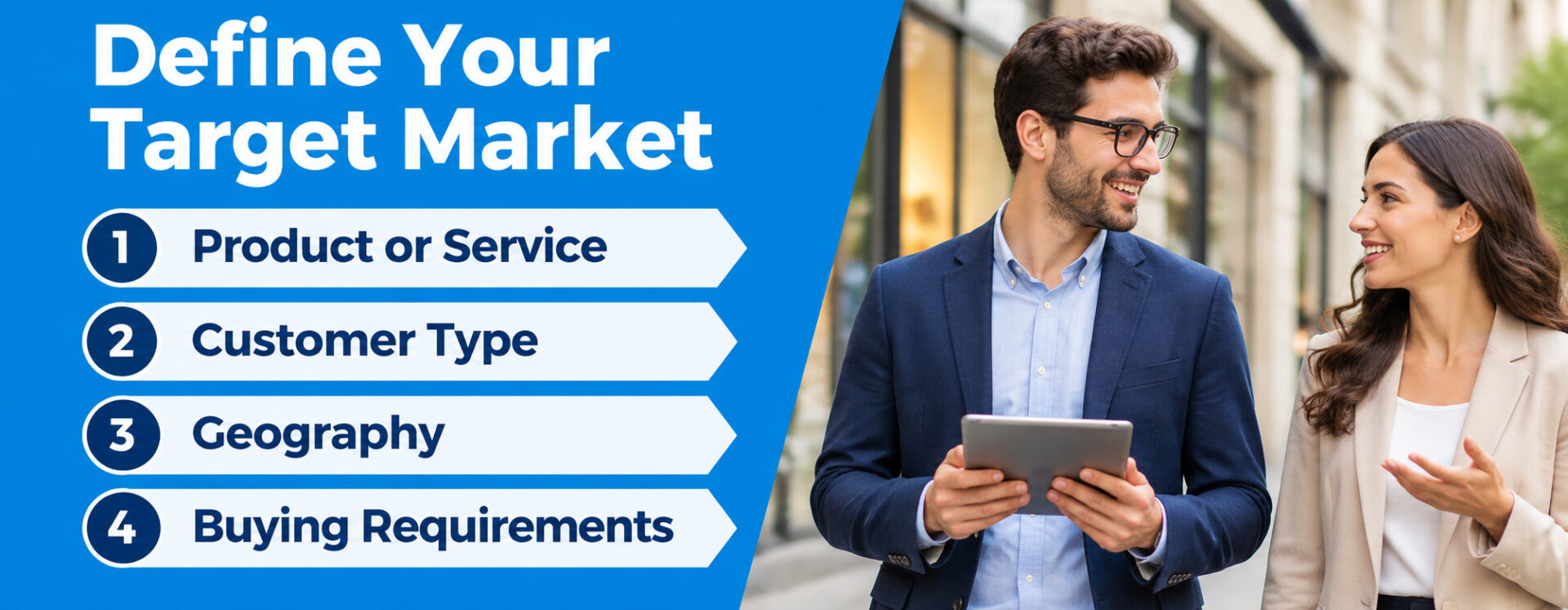
Before calculating market size, describe exactly which customers belong in the market. Labels such as healthcare, construction, or retail are usually too broad because each contains buyers with different needs and budgets. Scheduling software for independent clinics, for example, addresses a different market from equipment sold to hospital systems.
Define the offer, customer type, geography, and buying requirements. B2B criteria may include industry, employee count, revenue, and location; consumer criteria may include household type, income, age, and purchasing behavior. Existing customers can reveal which profiles adopt and remain customers.
An Ideal Customer Profile describes the organizations most likely to need the product, afford it, and become valuable customers. Jared’s Leads has a practical guide to building an Ideal Customer Profile. Use this type of definition to decide which businesses or households belong in the market estimate instead of counting everyone in a broad category.
Step 2: Calculate TAM, SAM, and SOM in the Correct Order
TAM, SAM, and SOM are related measures that narrow the same market opportunity. TAM is the largest, SAM is a subset of TAM, and SOM is a subset of SAM. Use the same product definition, time period, and revenue basis for all three figures.
- TAM, Total Addressable Market: The total annual revenue opportunity if the product could serve every potential customer in the defined market. It is a theoretical ceiling, not a sales forecast.
- SAM, Serviceable Addressable Market: The part of TAM the company can serve with its current product, geography, pricing, distribution, and operating model.
- SOM, Serviceable Obtainable Market: The part of SAM the company can realistically win over a defined period, given competition, sales capacity, marketing budget, conversion rates, and resources.
Imagine a workforce management software company identifies 10,000 businesses worldwide that could use its product. At an annual contract value of $4,000 per customer, its illustrative TAM is 10,000 × $4,000 = $40 million per year. The company can currently serve only 2,500 of those businesses because of language, support, and geographic limits. Its SAM is 2,500 × $4,000 = $10 million per year. Based on its sales capacity, it believes it can win 80 customers in the near term. Its SOM is 80 × $4,000 = $320,000 in annualized revenue once those customers are active.
These figures are illustrative, not a forecast. The customer counts and contract value need credible support; a company should not claim it can capture a percentage of a large market without explaining how its sales plan can deliver those customers. Stripe’s guide to TAM, SAM, and SOM explains the framework and common mistakes. After sizing the potential, Jared’s Leads’ targeted audience data options can help businesses assess whether their defined customer criteria can be translated into an identifiable audience.
Visual content:
- TAM: 10,000 potential businesses × $4,000 = $40 million annually.
- SAM: 2,500 businesses the company can serve × $4,000 = $10 million annually.
- SOM: 80 customers realistically acquired × $4,000 = $320,000 annualized revenue.
Alt text: TAM, SAM, and SOM funnel showing a software company’s opportunity narrowing from $40 million TAM to $10 million SAM and $320,000 SOM.
Step 3: Use Top-Down and Bottom-Up Market Sizing
Top-down sizing starts with a broad industry estimate and narrows it to the target segment, such as commercial properties in a state that outsource landscaping. Broad reports provide context but may include customers the company cannot serve.
Bottom-up sizing starts with identifiable customers and likely spending: number of suitable customers × expected annual revenue per customer. If 1,200 suitable businesses each represent a $7,500 annual contract, the estimated opportunity is $9 million. Check the count against the service area and validate contract value using actual sales or customer research.
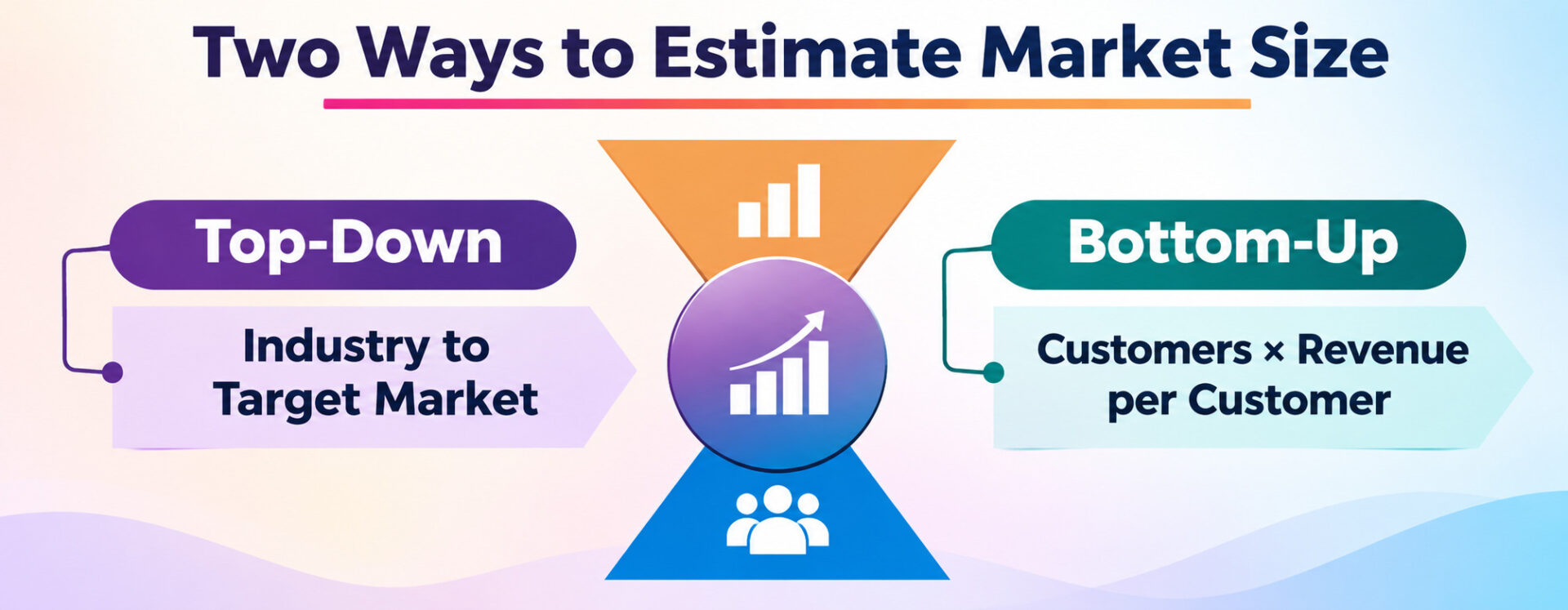
Use both methods. Top-down research tests the wider opportunity, while bottom-up analysis exposes the assumptions behind the customer count and expected spend. For B2B research, industry classifications can help define which businesses belong in the target audience. See Jared’s Leads’ explanation of SIC and NAICS codes.
Step 4: Find Reliable Data to Support the Estimate
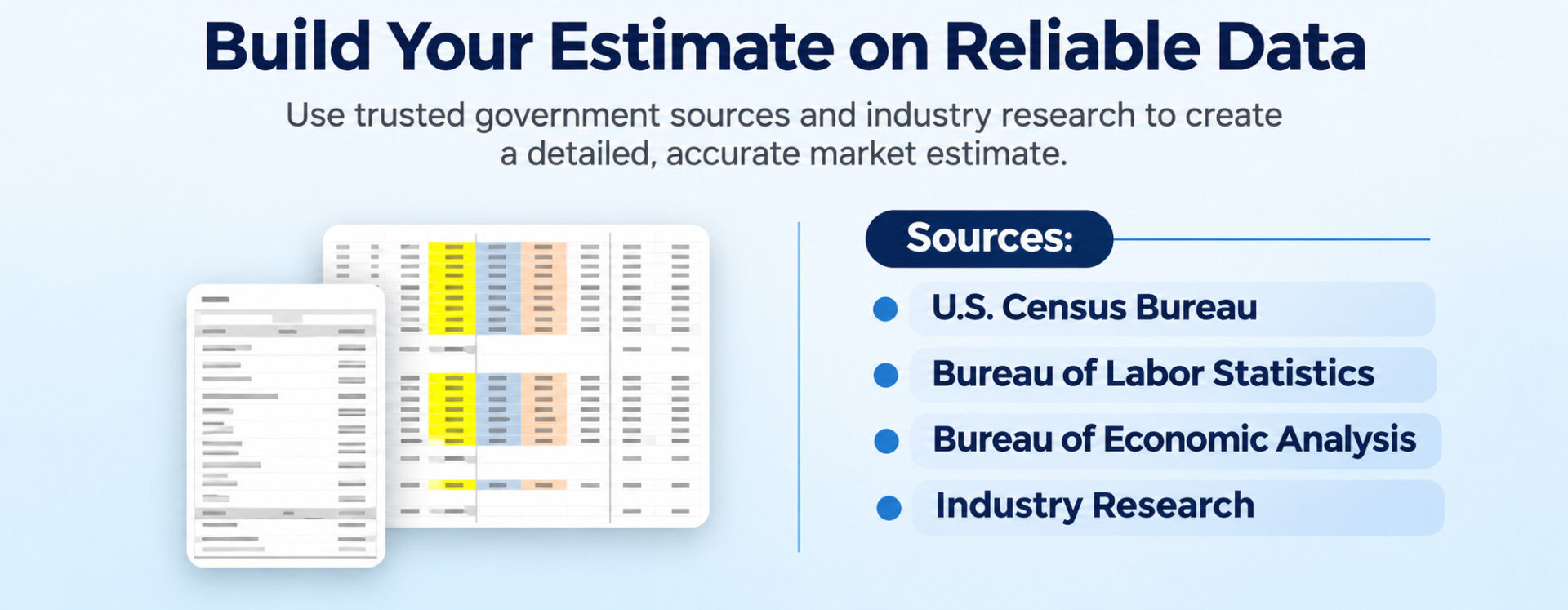
A market calculation is only as credible as its data. Combine official statistics with industry research, competitor information, customer interviews, and sales records. Record each source’s date, geography, definitions, and limitations. Distinguish firms, establishments, locations, employees, households, and contacts because these are not interchangeable units.
For U.S. research, use sources such as:
- S. Census Bureau, County Business Patterns: Annual data about employer establishments by industry, employment size, and geography. Check its program guidance and coverage before relying on a release.
- S. Census Bureau, Statistics of U.S. Businesses: Annual information about firms and establishments by industry, geography, and enterprise size. Its coverage focuses on businesses with paid employees. See Statistics of U.S. Businesses.
- Bureau of Labor Statistics, Quarterly Census of Employment and Wages: Employment, establishment, and wage information by industry and geography. It helps assess an industry’s scale and labor profile, but does not measure customer demand. See the QCEW overview.
- Bureau of Economic Analysis: Regional GDP and personal income information can help compare the economic conditions of counties and other areas. See GDP by County.
Government statistics are a starting point, not proof that a customer will buy. An establishment count helps estimate a business population, but the company must still identify which businesses have a need and budget. Jared’s Leads explains how SIC and NAICS codes can help define an audience, while noting that a code alone does not show intent to buy.
Step 5: Look for Underserved Segments and Untapped Opportunities
An untapped opportunity need not be an industry without competitors. It may exist where a customer group is overlooked, existing solutions fall short, or suitable providers are hard to access. The task is to find a real customer problem and evidence of demand, not assume every gap is attractive.
Compare customer groups and locations. Large providers may focus on enterprise accounts, leaving smaller organizations with products that are too expensive or complex. A specialist may serve them with a simpler offer. Geographic gaps can also matter, although limited competition may indicate weak demand or operating barriers.
Customer dissatisfaction can reveal unmet needs. Repeated complaints about price, delays, limited customization, difficult onboarding, or poor support may indicate a gap. Look for patterns across interviews, reviews, and sales conversations. Changes in technology, regulations, or buying behavior can also create demand in adjacent markets.
Once a potential segment is identified, compare it with other segments rather than assuming it is automatically the best one. Jared’s Leads’ guide to segmenting a lead list offers a related framework for grouping audiences by meaningful characteristics.
Step 6: Evaluate the Competitive Landscape
Strong demand does not guarantee an easy entry. Competitors may have loyal customers, established brands, lower costs, or stronger distribution. Identify direct competitors and indirect alternatives, then examine their target segments, pricing, service, reputation, reach, and customer experience.

Understand what customers can already buy, why they choose it, and where a new offer could add value. The opportunity may be an overlooked segment, a missing service, a simpler buying process, or a better-fitting price. Consider switching costs too: customers may stay with an imperfect provider if changing is expensive or disruptive.
The SBA recommends reviewing competitor strengths and weaknesses, market share, barriers to entry, and indirect competition. For a related view of how businesses evaluate and prioritize prospects, read Jared’s Leads’ article on prioritizing B2B leads.
Step 7: Validate Customer Demand Before Investing

Secondary research cannot confirm that customers will buy from a new provider. Test assumptions with people in the market. Interviews with owners, procurement managers, or department heads can reveal current solutions, needs, budgets, buying processes, and reasons to switch. Consumer businesses can use surveys and focus groups.
A limited pilot provides more evidence. Test one segment or a small geographic area before launching across a region. Define success in advance and measure qualified enquiries, conversion, average revenue, acquisition cost, retention, and feedback. If customers show interest but will not pay the required price, revise the offer or reconsider the market.
Treat validation as a learning process, not an exercise in confirming the original idea. Record negative feedback, revise assumptions, and test again where justified. The SBA outlines direct research methods in its market research guidance. For businesses testing outreach as part of a pilot, Jared’s Leads has a guide to building a multi-channel B2B prospecting campaign.
Step 8: Test the Financial Case for Entering the Market
A market can have interested customers and still be financially unattractive. Estimate acquisition and service costs, including sales, marketing, staffing, distribution, product adaptation, compliance, onboarding, and support. Compare these with revenue, gross margin, retention, and the time needed to recover the investment.

Build conservative, expected, and optimistic scenarios rather than relying on one forecast. The conservative case should test slower demand, lower conversion, or higher costs. The expected case should use evidence, while the optimistic case shows what stronger adoption could deliver. Account for sales and operating capacity: a market may contain thousands of prospects, but the opportunity is limited by how many the business can reach, convert, and serve.
Jared’s Leads’ article on measuring the ROI of a purchased lead list explains related principles for comparing prospecting costs with campaign outcomes.
Step 9: Make the Market Entry Decision
The decision should combine demand, customer fit, accessibility, competition, financial viability, and operational readiness. A large market may be unsuitable if the company cannot reach buyers or deliver profitably. A smaller market may be more attractive when customer needs and the route to market are clear.

Before approving expansion, ask: Is demand evident? Are enough suitable customers available? Can the company reach them sustainably? Why would customers choose this offer? Can the business deliver consistently? What results would cause management to pause or invest further?
A staged entry is often more prudent than committing to a full launch. Begin with one region or segment, measure performance against agreed targets, and expand only when the evidence supports it. Jared’s Leads’ guide to building a B2B prospecting strategy provides further context for turning a defined audience into an executable plan.
How Jared’s Leads Can Help Businesses Evaluate a Target Audience

Market sizing requires independent research and customer validation. After defining an audience, a company may need to check whether matching businesses or households can be identified. Jared’s Leads provides targeted business and consumer data using available criteria such as industry, geography, company size, revenue, and professional role.
A tailored audience count estimates how many records match selected criteria. It is one research input, not the total market size or proof of purchase intent. Explore Jared’s Leads audience data or request a free data sample and count.
Frequently Asked Questions
For more practical guidance on defining and reaching business audiences, see Jared’s Leads’ business growth resources.
Q.1. What is the easiest way to estimate market size?
Define the customer group and geography, estimate the number of suitable buyers, and multiply by realistic annual revenue per customer. Check the result against industry data and customer research.
Q.2. What is the difference between market size and market opportunity?
Market size is the potential customer or revenue pool. Market opportunity is the portion a business can serve and capture after considering demand, competition, reach, and costs.
Q.3. How can a business identify an untapped market?
Look for customer groups whose needs are not being met, geographic areas with demand but limited suitable options, recurring customer complaints, and changes that create new requirements. Investigate why the gap exists and confirm that customers are willing to pay before treating it as an opportunity.
Q.4. What do TAM, SAM, and SOM mean?
TAM means Total Addressable Market, the full theoretical revenue opportunity. SAM means Serviceable Addressable Market, the portion a company can serve with its current business model and reach. SOM means Serviceable Obtainable Market, the portion it can realistically win in a defined period. The relationship is TAM ≥ SAM ≥ SOM.
Q.5. Which U.S. government sources can help with market research?
The Census Bureau’s County Business Patterns and Statistics of U.S. Businesses provide establishment data. BLS QCEW provides employment and wage data, while BEA publishes regional economic information. Review coverage and definitions before comparing figures.
Q.6. How can a small business test a market without a large investment?
Interview prospective customers, run a limited survey, test a small campaign, or launch a pilot in one geographic area. Set success measures in advance and evaluate conversion, acquisition cost, revenue, and feedback before expanding.
Q.7. Does having fewer competitors mean a market is a good opportunity?
Not necessarily. Low competition may indicate an underserved segment, but it can also reflect weak demand, difficult operating conditions, or unattractive economics. Research why competitors are absent and confirm that customers have a genuine need before investing.
Final Thoughts: Base Market Expansion on Evidence

Market sizing is not about producing the largest possible number for a business plan. It is about understanding whether enough suitable customers exist, whether the company can reach them, and whether serving them can be sustainable. A smaller market with clear demand may be more attractive than a larger market with prohibitive competition or costs.
Businesses that combine reliable data, customer research, competitor analysis, realistic financial assumptions, and controlled market tests are better equipped to make expansion decisions. The important question is not simply how big a market looks, but whether the business can solve a real customer problem and build a profitable position over time. For the next step from audience definition to outreach planning, see Jared’s Leads’ B2B prospecting strategy guide.