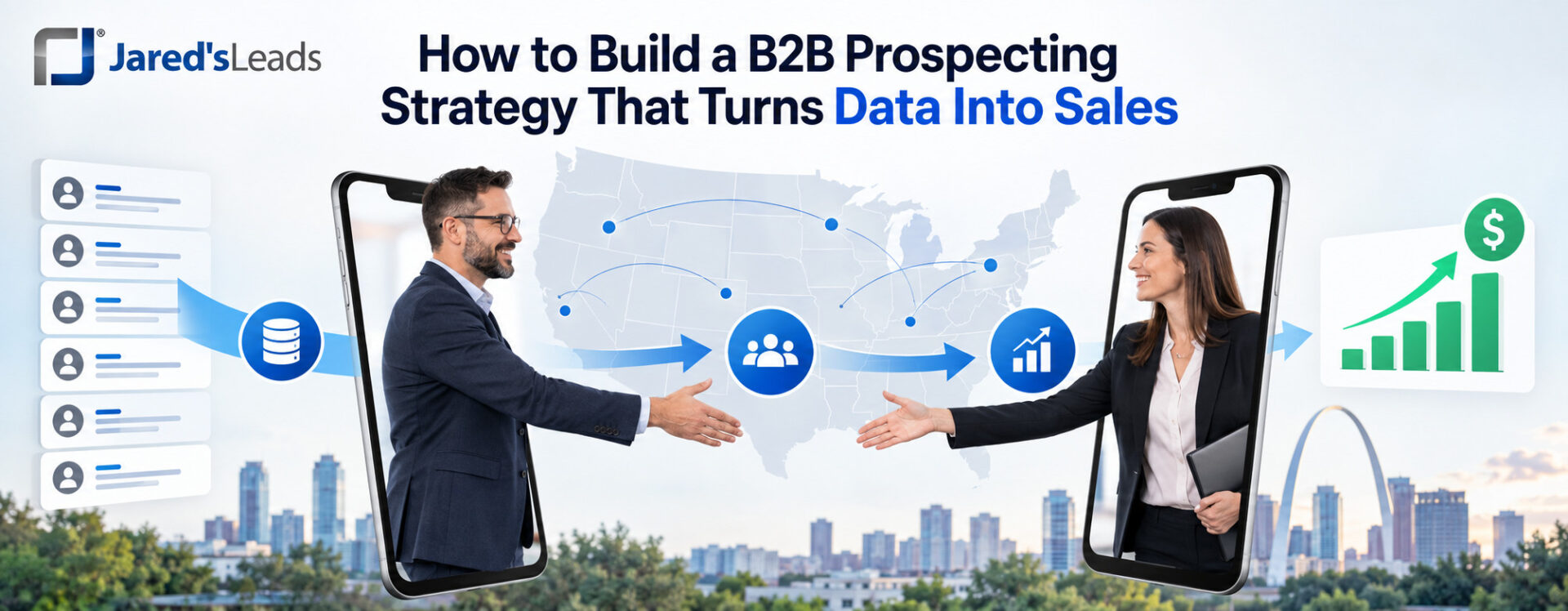
B2B prospecting is often treated as a numbers game. Find enough companies, collect enough contacts, send enough emails, make enough calls, and eventually some of those prospects will become customers. That approach can produce activity, but activity alone is not a prospecting strategy. A strong B2B prospecting strategy starts with knowing exactly who you want to reach, understanding why they might buy, building data around that audience, and creating a process that moves the right prospects toward a sales conversation.
The difference becomes especially important when a company already has access to a large amount of customer or prospect data. A database can contain thousands or even millions of records and still contribute very little to revenue if the sales team does not know which records matter, who inside those companies should be contacted, what message should be used, or when the prospect should be approached. Data becomes valuable when it helps a sales team make better decisions.
That is why the goal of B2B prospecting should not simply be to generate more names. The goal should be to create a repeatable system that turns relevant business data into conversations, opportunities, and eventually sales.
What Is a B2B Prospecting Strategy?

A B2B prospecting strategy is the process a business uses to identify potential customers, determine which prospects are most relevant, reach the appropriate decision makers, and move those prospects into the sales pipeline. It connects audience research and data with actual sales activity, rather than treating lead generation as a separate task from selling.
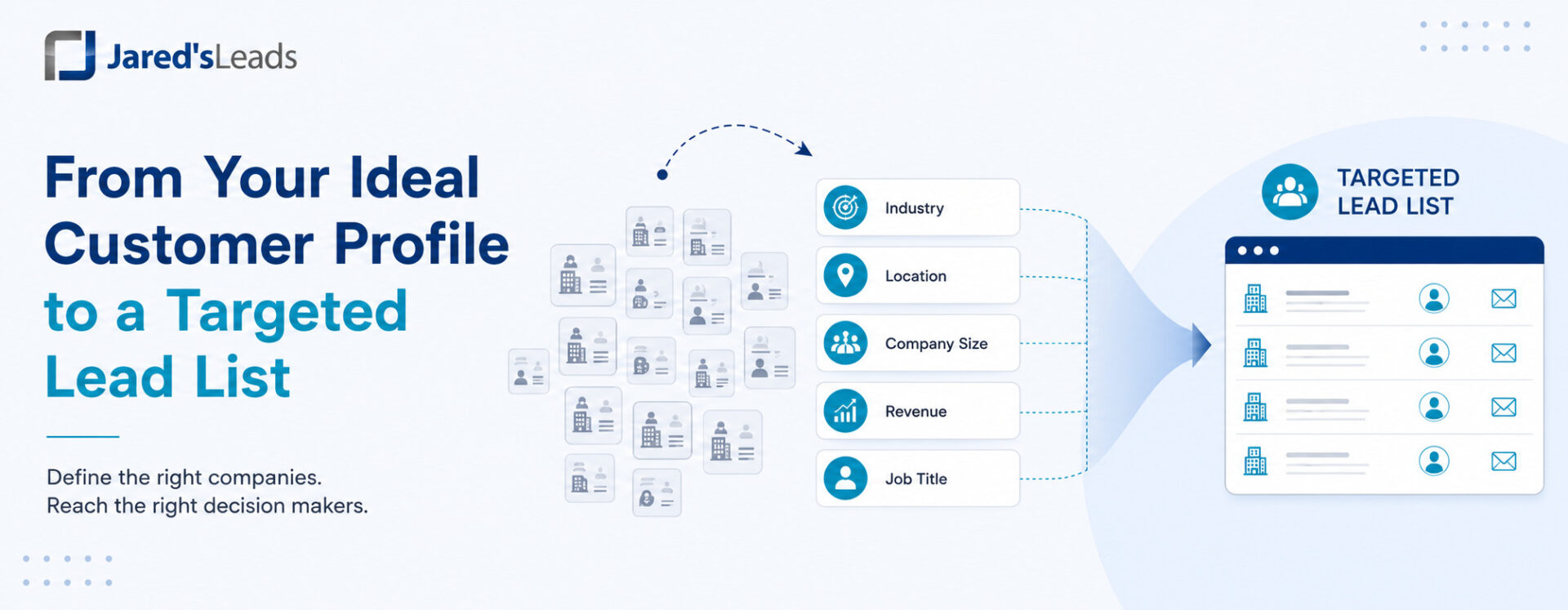
A useful strategy begins with the company’s ideal customer profile. That profile might include industry, geographic location, company size, annual revenue, number of employees, technology used, job function, seniority, or other characteristics that indicate whether a company is likely to need the product or service. Once those characteristics are defined, prospecting becomes much more focused because the sales team is no longer trying to speak to everyone.
Jared’s Leads approaches targeted data in much the same way. Its targeted marketing and contact lists can be built around factors such as industry, location, job title, company size, and other campaign requirements, giving businesses a more practical starting point for B2B outreach.
The strategy then needs to connect that audience definition to execution. The business must decide how it will contact prospects, what information it will use in the message, how it will follow up, and which metrics will determine whether the approach is working. Without those pieces, even accurate data can become another unused spreadsheet.
Start With a Clear Ideal Customer Profile

The first step in building a B2B prospecting strategy is deciding exactly what a good prospect looks like. This sounds obvious, but many businesses begin prospecting with a vague description such as “small businesses,” “manufacturers,” or “companies that need marketing.” Those categories are usually too broad to guide an effective campaign.
A useful ideal customer profile should describe the characteristics that make an account commercially relevant. For example, a software company might want to reach U.S. manufacturers with 100 to 500 employees that have a dedicated operations team. A commercial insurance provider might focus on companies within particular industries and revenue ranges. A marketing agency may want companies with a specific employee count and a senior marketing decision maker.
The more clearly you define the audience, the easier it becomes to build the rest of the prospecting process. Your data requirements become clearer, your messaging becomes more relevant, and your sales representatives spend less time researching companies that were never a strong fit.
This is also where it helps to separate an ideal customer profile from a simple contact list. An ICP describes the type of organization you want. The prospecting database then identifies actual companies and people who fit that description. Jared’s Leads’ B2B email lists can be targeted by industry, SIC or NAICS classification, geography, company size, revenue, and job title, among other criteria.
A strong ICP should also be practical. If your sales team cannot explain why a particular company belongs in the target audience, the definition is probably not specific enough.
Turn Your ICP Into Useful Data Requirements

Once the ideal customer profile is defined, the next step is translating it into data fields. This is where many prospecting programs lose focus. A business may know the type of company it wants to reach but fail to identify the information necessary to find and prioritize those companies.
Think about the data your sales team actually needs to begin a conversation. Company name and industry may be enough for one campaign, while another may require a specific decision maker, job title, business email, phone number, location, employee count, or revenue range. The right fields depend on what you are selling and how your sales process works.
This does not mean collecting every available field simply because it exists. More data is not automatically better data. The objective is to collect the information that helps your team determine fit, personalize outreach, select the right channel, and decide what happens next.
For example, a company selling enterprise software may care deeply about technology environment, employee count, department structure, and executive roles. A regional service provider may care more about geography, business category, location, and the person responsible for purchasing. Building the database around those requirements makes the resulting prospect list much more useful.
Businesses that already have a customer or prospect database should also examine whether important information is missing. Jared’s Leads provides data services and list management designed to help businesses clean, verify, enrich, and prepare existing records for marketing use.
The important point is that data should serve the prospecting strategy. The strategy should not be built around whatever data happens to be available.
Segment Prospects Before You Start Selling

Once you have a relevant prospect universe, avoid putting every record into the same campaign. Segmentation allows your sales and marketing teams to organize prospects into groups that share meaningful characteristics.
A useful B2B segmentation strategy might separate prospects by industry, company size, geography, job title, revenue range, sales territory, or business need. It can also distinguish between prospects that are completely new to the company and prospects that have interacted with the brand before.
The purpose is not simply to create smaller lists. The purpose is to make the conversation more relevant. A CFO and a marketing director may work for the same company, but they are unlikely to respond to the same message. Similarly, a 25 employee company and a 2,500 employee organization may have completely different purchasing processes even when they operate in the same industry.
Segmentation can also help sales teams prioritize their time. A business might create a high priority segment for companies that closely match its ICP, a second group for companies that meet most but not all criteria, and a broader segment for market development. That creates a logical progression instead of asking representatives to treat every record as equally valuable.
Jared’s Leads supports this kind of targeted approach by allowing businesses to define lists around industry, geography, job title, company size, revenue, SIC, NAICS, and other criteria. Its B2B email database solutions are specifically positioned around building contact data around the customer’s target audience rather than relying on a generic database.
Decide Who You Actually Need to Reach

A company is not the same thing as a buyer. One of the most common mistakes in B2B prospecting is identifying the right organizations but failing to identify the right people inside them.
Depending on the product or service, the decision maker could be an owner, CEO, CFO, CIO, operations executive, procurement manager, sales leader, marketing director, or another stakeholder. In larger organizations, several people may influence the purchase even if only one person signs the agreement.
Your prospecting strategy should therefore identify the roles involved in the buying process. Start with the person most likely to own the problem you solve, then consider other stakeholders who may influence the decision. This makes the outreach more precise and gives the sales team a better understanding of the account.
The message should also reflect the role. A finance executive may care about cost, efficiency, and financial impact, while an operations leader may care more about productivity, implementation, and workflow. The underlying product has not changed, but the reason for paying attention can be very different.
This is one reason a well structured business contact database can be more valuable than a large collection of generic company names. Jared’s Leads supports business email targeting by allowing businesses to identify contacts according to job title and other company level characteristics.
Match the Outreach Channel to the Prospect

There is no single communication channel that works for every B2B prospect. Email may be appropriate for one audience, while phone outreach, direct mail, or a combination of channels may work better for another.
The important question is not whether email or phone is universally better. The question is which channel fits the audience, the offer, and the sales process. A high value B2B sale may justify multiple coordinated touches, while a simpler offer may require a shorter sequence.
This is where multichannel prospecting becomes useful. An organization might introduce itself through email, follow with a phone call, send additional information, and then have a sales representative follow up with qualified prospects. The purpose is not to bombard the prospect. It is to create a consistent path through which a relevant prospect can understand the offer and decide whether a conversation is worthwhile.
Jared’s Leads offers several data and campaign options that can support different outreach approaches, including telemarketing lists for phone based campaigns and targeted email data for digital outreach.
The best channel strategy is the one your sales team can execute consistently and measure accurately.
Build a Follow Up Process Before You Launch
Getting the first response is not the end of prospecting. In many B2B sales processes, it is the beginning.
A prospect may open an email without replying, speak briefly with a representative and ask for information, or express interest but not be ready to make a purchasing decision. Without a defined follow up process, those prospects can disappear from the pipeline even though they may still have value.
Your strategy should establish what happens after the first touch. Decide when the next contact occurs, which channel will be used, who owns the prospect, what information should be recorded, and when a prospect should be moved into a longer term nurture process.
This is particularly important when prospecting at scale. A spreadsheet may work for a small campaign, but larger programs require consistent processes for assigning leads, tracking responses, and reminding representatives about follow up.
For companies working with fresh inbound or high intent opportunities, timing becomes even more important. Jared’s Leads provides real time leads designed around faster follow up, with options for routing and LeadWave support for organizing reminders and follow up workflows.
The best prospecting database in the world cannot compensate for a sales process that repeatedly forgets to follow up.
Measure the Parts of the Strategy That Affect Revenue

Prospecting metrics can quickly become overwhelming. Open rates, click rates, calls, conversations, meetings, opportunities, conversion rates, and revenue can all tell you something. The key is understanding which numbers actually help you improve the strategy.
Start by measuring activity, but do not stop there. Activity tells you what the sales team is doing. Conversion data tells you whether those activities are producing useful outcomes.
For example, if a segment generates a high number of contacts but almost no meetings, the audience definition, message, offer, or channel may need attention. If a segment generates meetings but very few opportunities, the problem may be qualification or the fit of the offer. If opportunities are strong but deals are not closing, the issue may be further down the sales process.
Revenue should ultimately connect back to the audience and campaign that generated the opportunity. That allows you to determine which segments deserve more investment and which should be reduced or removed.
Jared’s Leads also emphasizes targeted data and campaign support rather than simply providing a large database. Its marketing data solutions bring together targeted data, lead generation, campaign solutions, and follow up support.
This is where prospecting becomes an optimization process rather than a one time list purchase.
Keep Improving the Strategy With What Sales Learns
A B2B prospecting strategy should never remain exactly the same. Your sales team will learn which industries respond, which job titles engage, which objections appear repeatedly, and which offers create meaningful conversations. Those observations should make their way back into the data and targeting strategy.
Suppose a company begins by targeting businesses across an entire industry and discovers that companies between 100 and 500 employees respond substantially better than smaller organizations. That insight should influence the next campaign. If one geographic market produces stronger opportunities, that should influence allocation. If one decision maker consistently responds better than another, the messaging and targeting should reflect it.
This feedback loop is one of the most valuable parts of prospecting. Data determines who you approach, outreach generates responses, sales activity produces information, and those results improve the next audience.
Businesses can also use data services to maintain the underlying database as the strategy evolves. Jared’s Leads provides services for data cleaning, verification, enrichment, and list management, which can help organizations maintain usable records as their prospecting programs grow.
The goal is to create a prospecting system that gets smarter with every campaign.
How Jared’s Leads Helps Turn Your Data Into Sales

Jared’s Leads is useful when a business knows it needs better prospecting data but does not want to build the entire process around a generic database. The company provides targeted business and consumer data, email lists, mailing lists, phone lists, lead options, data services, and campaign support. Its homepage describes a process built around defining the target audience, building a custom list, and delivering verified data in formats that can be used for campaigns.
For B2B prospecting, the value is in connecting the audience definition to the actual records your sales team needs. Instead of beginning with an enormous database and trying to filter it afterward, you can start with the characteristics that matter to your campaign and build the audience around those requirements.
That can include industry, location, company size, revenue, SIC or NAICS classification, job title, and other available fields. The result is a prospecting foundation that is much closer to the audience your sales team actually wants to reach. Jared’s Leads also provides options across email, phone, mailing, and other channels, which makes it possible to align the data with the way your team intends to prospect.
The company also gives businesses a way to discuss their requirements before committing to a campaign. Its contact page allows businesses to request a free count, discuss targeting options, ask about campaign requirements, and speak with a data specialist.
That conversation can be particularly useful when the audience is complicated or when a company is unsure which fields it actually needs. The right prospecting strategy does not begin with buying as much data as possible. It begins with understanding who you need, what you need to know about them, and what your sales team will do once the data arrives.
Common B2B Prospecting Mistakes to Avoid
One of the biggest mistakes is starting with volume instead of relevance. A list containing 100,000 contacts may look impressive, but if only a small percentage fit your ICP, your sales team has simply inherited a larger filtering problem.
Another mistake is treating every prospect the same. B2B buyers have different responsibilities, priorities, budgets, and purchasing authority. A message that makes sense to a business owner may be irrelevant to a procurement manager or technology executive.
A third problem is failing to establish follow up before launching outreach. If representatives do not know what happens after the first email or call, valuable prospects can be lost simply because nobody owns the next step.
Finally, businesses often measure the wrong outcome. More calls or more emails can make a campaign look productive without demonstrating that it is generating qualified opportunities. Prospecting should ultimately be evaluated by the quality of conversations, opportunities, pipeline, and revenue it creates.
Frequently Asked Questions About B2B Prospecting
Q.1. What is the difference between B2B lead generation and B2B prospecting?
B2B lead generation is the broader process of creating or identifying potential sales opportunities, while prospecting is the active process of finding and approaching potential buyers. The two work together. Lead generation can create or source the opportunity, while prospecting turns that opportunity or target account into a sales conversation.
Q.2. How do I know who my business should prospect?
Start with the customers who are already a strong fit for your product or service and identify the characteristics they share. Look at industry, company size, geography, revenue, job roles, business model, and the problem your product solves. Those characteristics can form the foundation of your ideal customer profile and guide your future prospecting.
Q.3. How important is data quality in B2B prospecting?
Data quality is fundamental because poor information creates wasted sales activity. Incorrect contact details, outdated records, irrelevant companies, or missing decision makers can make a campaign appear unsuccessful when the real problem is the underlying audience. Good prospecting requires data that is relevant to the campaign and usable by the sales team.
Q.4. Should B2B companies use email, phone, or multiple channels?
The right approach depends on the audience, product, sales cycle, and resources available to the sales team. In many situations, combining channels can create a more consistent prospecting process because prospects may respond differently to email, phone, direct mail, or other forms of outreach. The important part is coordinating those channels rather than using them independently.
Q.5. How can I improve my B2B prospecting results?
Start by improving the audience before increasing the volume. Review your ideal customer profile, segment your prospects, make sure you are reaching the right decision makers, align the message with each segment, establish a consistent follow up process, and measure which segments actually generate qualified opportunities and revenue. Improving those fundamentals will usually create more value than simply adding more names to the database.
Final Takeaway

A successful B2B prospecting strategy is not built around having the biggest database or sending the greatest number of messages. It is built around relevance. You need to know which companies are worth pursuing, which people inside those companies matter, what information your sales team needs, how those prospects should be approached, and what happens after the first conversation.
The most valuable data is therefore not necessarily the data with the greatest volume. It is the data that helps your sales team make better decisions. When your audience definition, prospect records, segmentation, messaging, follow-up, and measurement all work together, your database becomes more than a collection of contacts. It becomes a working part of your sales strategy.
Jared’s Leads can help businesses build that foundation by combining targeted data with list building, lead generation, data services, and campaign support. If you already know the audience you want to reach, you can start with Jared’s Leads and define the data requirements around your campaign. If you are still working through the audience or need help determining what information is available, contact Jared’s Leads to discuss your targeting requirements and request a free count.
The objective is simple: stop treating data as the end product and start using it as the starting point for better sales conversations.