A high-quality lead list requires a precise Ideal Customer Profile (ICP), verified contact data and active buying signals. These core elements ensure higher response rates and prevent wasted sales effort
Let’s say you have purchased a lead list for your marketing campaign. You send out emails, but hardly anyone sees it or the bounce rate is significantly high, half of the “decision-makers” on your lead list no longer work, and many of the contacts have already moved to other companies.
Poor data quality wastes time, reduces campaign performance, and increases acquisition costs. Most lead lists become worthless before the initial email is sent, and we understand why; the main difference between a lead list that adds value to your sales pipeline and one that drains your budget comes down to a handful of measurable factors. Accuracy, freshness, relevance, buying intent, and compliance determine whether your list generates opportunities or creates unnecessary work for your sales team.
This guide explains and identifies factors associated with high-quality lead lists and the standards you should expect when investing in marketing data, and the standards you should expect when investing in marketing data.
Why “High Quality” Is More Than a Marketing Claim
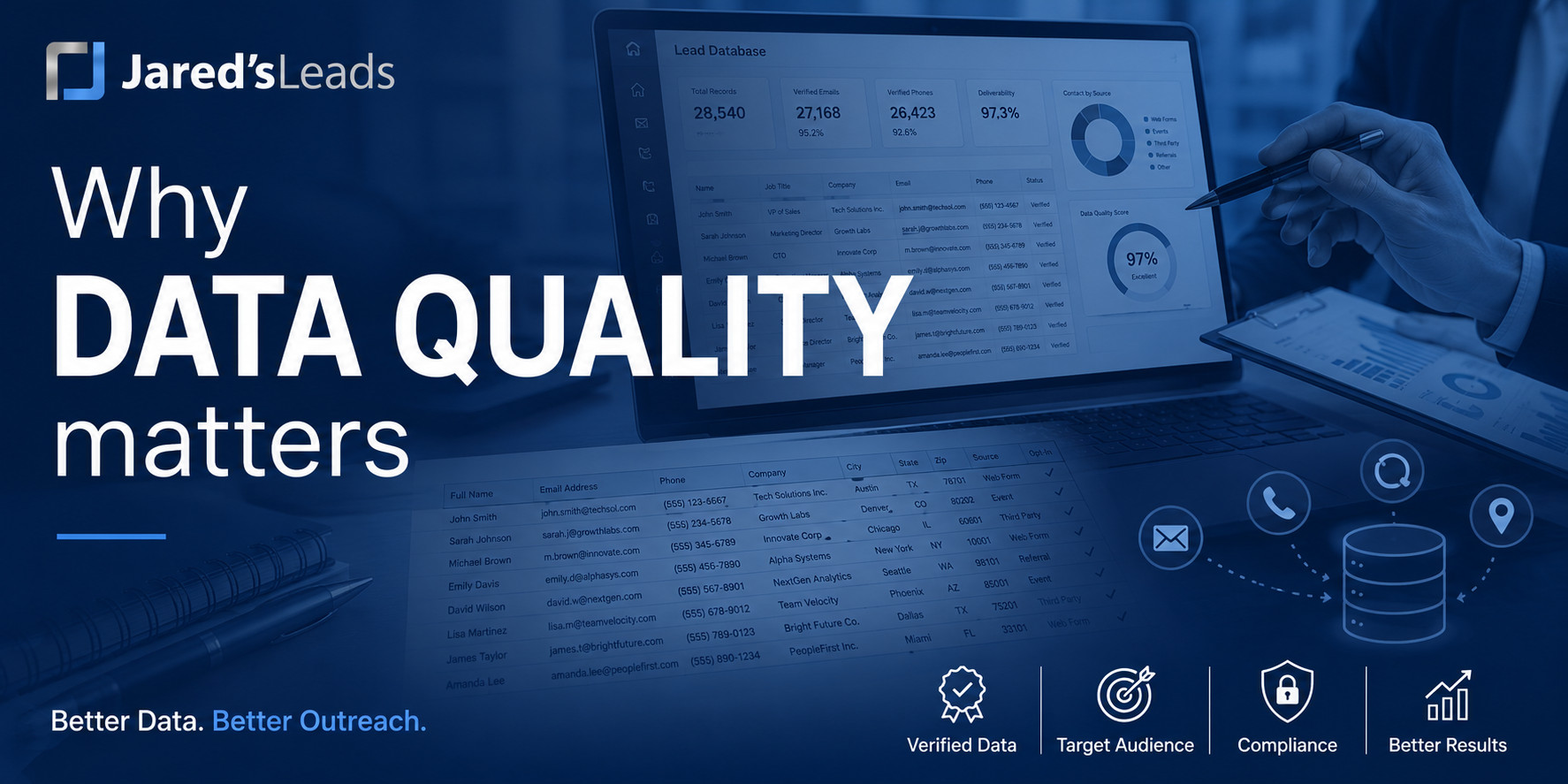
The claim of providing ‘high-quality’ leads is a universal constant across lead providers. You can find this promise emblazoned on their homepages, in their sales collateral, and throughout their marketing materials. But data quality isn’t something you promise in a pitch deck; it’s something you prove in the inbox. In reality, lead data quality varies far more than most buyers realise.
While elite data providers achieve accuracy rates above 97%, the industry average for standard providers hovers closer to a dismal 50%. In the current landscape, this means you could be sending half of your outbound messages to entirely outdated or unverifiable contacts. If you buy a list of 10,000 records and only 5,000 are deliverable, you haven’t purchased a targeted audience – you’ve bought a coin flip
This problem compounds over time. Data naturally decays as prospects change jobs, corporate domains shift, and phone numbers are reassigned. Even if a lead list is 100% accurate the day you buy it, it begins losing value the moment it lands in your CRM. The result? Wasted budget and burned sales hours chasing accounts that never had a chance of closing.
Clean data is the foundation of outbound success. If your data is corrupted, the rest of your go-to-market strategy falls apart your sales cadences, outreach messaging, and cold scripts won’t matter if they never reach a live human.
The Five Factors That Define a High-Quality Lead List
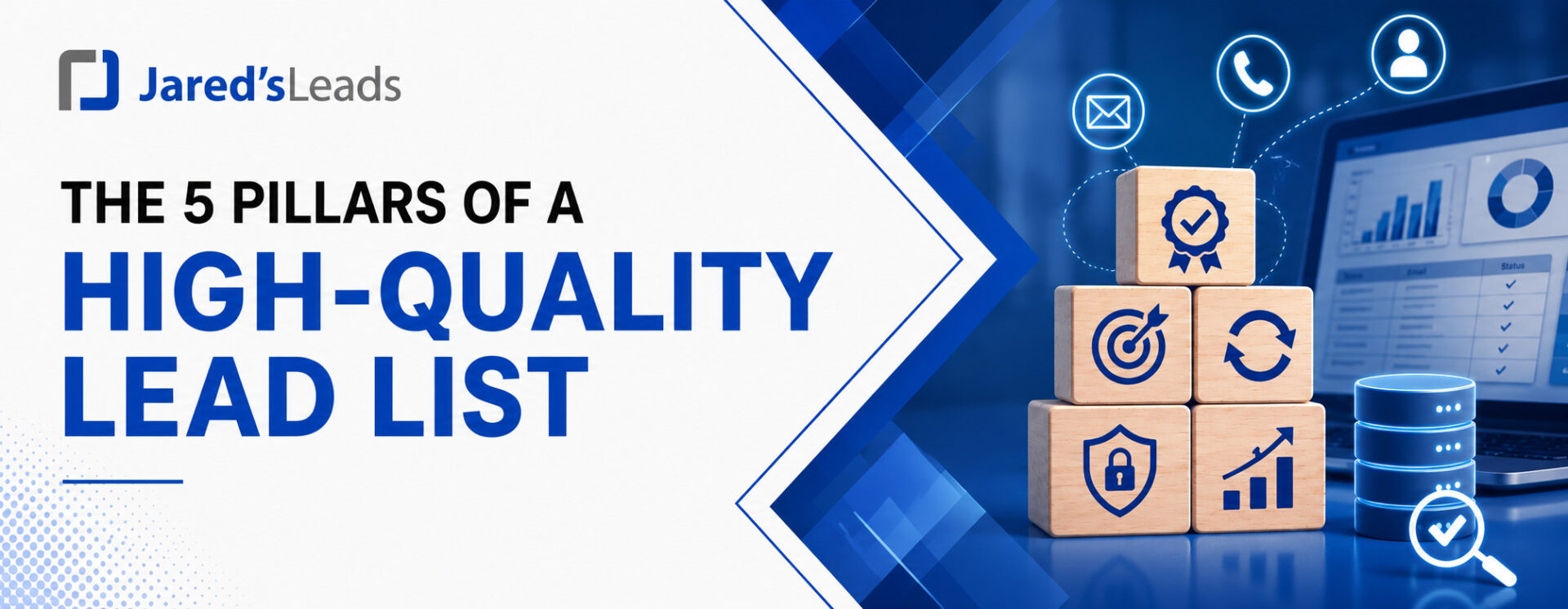
Factor 1: Field-Level Data Integrity
Every record should contain verified, up-to-date information, including the contact’s name, job title, company, email address, and phone number. Simply filling every field is not enough. Every data point should be validated to ensure it reflects current information.
Look for providers that regularly verify their records and offer replacement guarantees for invalid contacts. High deliverability rates and verified direct dial numbers are stronger indicators of quality than large database sizes alone.
Learn more about verified business data through Jared’s Leads‘ Business Email Lists and Business Mailing Lists.
Factor 2: Freshness and Continuous Re-Verification Cadences
B2B data decays at an average rate of 2.1% per month, meaning a clean lead list loses roughly 25% of its accuracy every year due to promotions, corporate restructuring, and employee attrition. Because corporate milestones occur constantly, database hygiene cannot be a retroactive fix; it must be a continuous process.
When evaluating data partners, audit their specific verification schedules. Data refreshed on rolling 30-day cycles consistently outperforms records subjected to stagnant quarterly or annual updates. Maintaining this high level of data freshness does more than just optimize campaign logistics, it protects your core domain reputation by keeping email bounce rates below the critical 2% threshold and maximizing direct-dial connection rates.
Factor 3: Granular Alignment with Your Ideal Customer Profile (ICP)
Even a 100% accurate lead list is useless if the contacts don’t match your target audience. A high-quality list moves beyond basic job titles and requires a multi-layered approach to qualification across three distinct data buckets:
- Firmographics: Precise revenue brackets, exact employee counts, and specific geographic footprints.
- Technographic: The prospect’s current hardware and software infrastructure, especially the tools your product replaces.
- Tiered Personas: Exact job functions and decision-making authority, rather than generic department headers.
Broad, generalised databases frequently result in low response rates and wasted sales cycles. To maximise your pipeline efficiency, look for custom data curation and industry-specific frameworks, such as Jared’s Leads‘ Business Email Lists to ensure your sales team focuses exclusively on high-yield opportunities that are highly likely to convert.
Factor 4: Intent Data and Active Buying Signals
Matching your ICP tells you who to target, but buying signals tell you when to reach out. The most valuable lead lists layer profile fit with real-time intent metrics, isolating organisations that are actively displaying operational needs.
High-density lists track critical corporate trigger events such as recent venture capital funding rounds, rapid hiring sprees within specific target departments, and the recent deployment of complementary software stacks. Reaching out to a prospect who fits your profile but lacks active intent results in a slow, uphill sales cycle.
Combining accurate contact data with timely, actionable buying signals allows sales teams to prioritise high-velocity accounts, significantly lifting campaign engagement and booking meetings precisely when the prospect’s need is most urgent.
Factor 5: Legal Compliance and Data Governance
Regulatory compliance is an inseparable component of data quality, transforming a standard lead list from a hidden liability into a secure corporate asset.
Authoritative data providers protect your business by running exhaustive screening protocols, including National Change of Address (NCOA) updates for direct mail, strict Do Not Call (DNC) registry scrubs for telemarketing, and verifiable opt-in frameworks that strictly align with GDPR and CCPA mandates.
Before executing a data purchase, sales operations must audit a vendor’s data processing agreements and collection methodologies; a transparent provider will readily supply this documentation rather than treating it as an administrative hurdle.
Prioritising verified compliance ultimately safeguards your domain’s sender reputation, mitigates severe legal liabilities, and preserves long-term brand equity across all outreach channels.
Related Lead List Topics You Should Understand
Evaluating lead list quality becomes much easier when you understand the related factors that influence campaign performance. While these topics are closely connected, each plays a distinct role in determining the success of your outreach.
Build vs. Buy Lead Lists
Building your own database through website forms, events, referrals, and content marketing typically results in higher engagement because every contact has expressed interest in your business. The downside is that building a qualified database takes time.
Purchasing a targeted lead list provides immediate access to prospects and allows sales teams to launch campaigns faster. The right choice depends on your budget, timeline, and growth objectives. If you choose to buy a list, ensure the provider can demonstrate data accuracy, regular verification, and compliance.
Data Enrichment
Basic contact information is only the starting point. Data enrichment adds valuable business intelligence such as company revenue, employee count, industry, technologies used, purchasing authority, and firmographic details.
Enriched data allows sales and marketing teams to personalise outreach, prioritise qualified prospects, and segment campaigns more effectively. Ask providers how often enriched data is updated, since outdated information can quickly reduce its value.
Audience Segmentation
A well-segmented database consistently outperforms a broad, one-size-fits-all list.
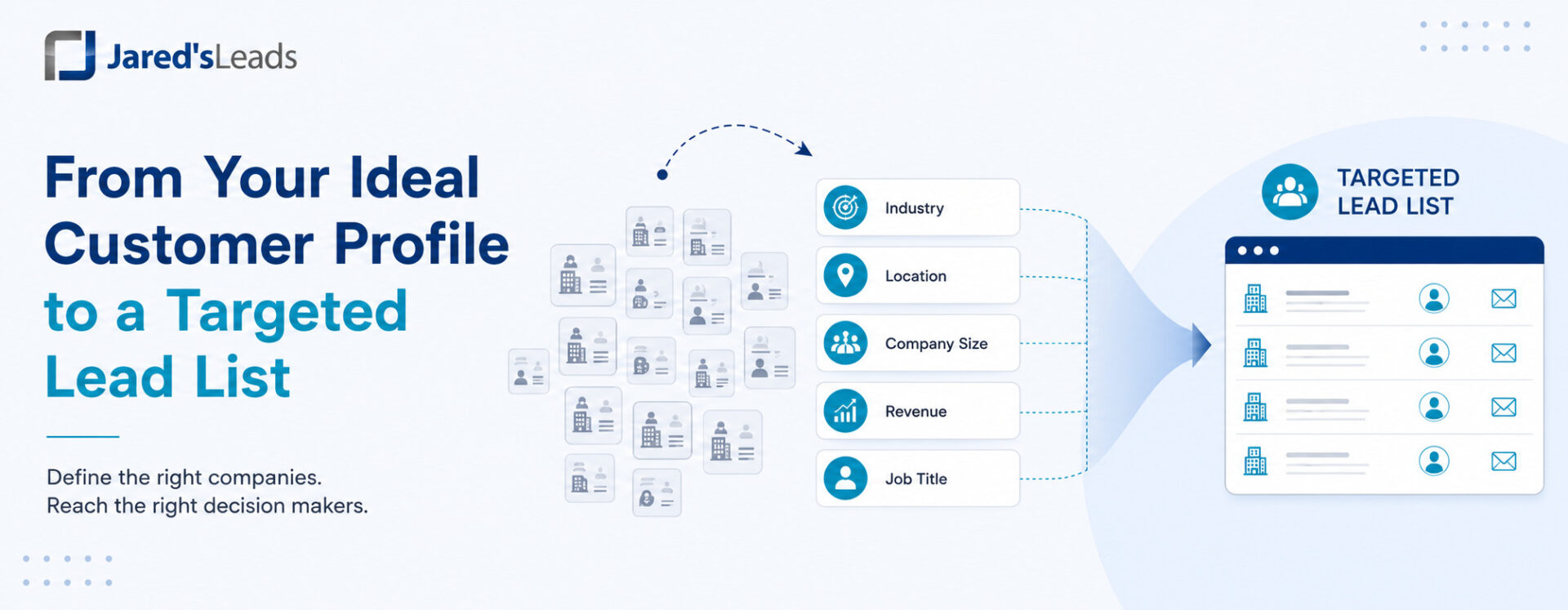
Segmenting contacts by industry, location, company size, job title, buying stage, or other relevant criteria enables more personalised messaging and stronger campaign performance.
Before purchasing data, confirm that your provider can build custom segments that match your target audience rather than delivering a generic database.
Explore Jared’s Leads’ Industry Mailing Lists and Consumer Mailing Lists for targeted audience options.
Lead Scoring
Not every prospect has the same potential value.
Lead scoring assigns priority based on characteristics such as company profile, buying intent, engagement, and demographic information. This helps sales teams focus on prospects with the greatest likelihood of becoming customers.
If lead scoring is available, ask how scores are calculated and whether they are based on current behavioural or firmographic data.
Choosing the Right List Type
Different marketing channels require different types of data.
- Email Lists support email marketing and outbound prospecting.
- Mailing Lists are designed for direct mail campaigns and should include address verification through recognised postal standards.
- Phone Lists support outbound calling and should contain verified direct dial or business phone numbers where available.
Each list should be verified using standards appropriate for its intended use. High quality email verification, for example, does not automatically guarantee accurate mailing addresses or telephone numbers.
Buying Committee Mapping
Many B2B purchases involve multiple stakeholders rather than a single decision maker.
A comprehensive lead list should include executives, department heads, influencers, budget owners, and end users where appropriate. Understanding the buying committee helps sales teams build relationships across an organisation rather than relying on a single contact.
Total Cost of Ownership
The advertised cost per contact rarely reflects the true cost of a lead list.
Additional expenses may include data cleansing, duplicate removal, CRM imports, manual verification, and time spent contacting outdated records.
Instead of comparing providers solely on price per contact, evaluate the total cost of acquiring qualified opportunities and closed business.
Ongoing List Management
Marketing databases require continuous maintenance.
Without regular updates, contact information naturally becomes outdated due to employee turnover, business closures, and organisational changes. Providers that offer ongoing list management services help businesses maintain higher data quality and improve long-term campaign performance.
Real Time vs. Compiled Data
Real-time leads are generated when prospects actively express interest, such as completing a form or requesting information. These leads often require immediate follow-up.
Compiled data is sourced from multiple verified databases and is best suited for outbound prospecting, account-based marketing, and large-scale campaigns.
Both approaches serve different purposes, and many businesses benefit from using a combination of each.
Regulatory Compliance
Compliance should never be an afterthought.
Responsible data providers maintain processes that support applicable privacy regulations and industry standards. Depending on the campaign type and geography, this may include GDPR, CCPA, Do Not Call screening, and National Change of Address processing.
Before purchasing any marketing database, ask how the data was collected, verified, maintained, and whether the provider can explain its compliance practices with confidence.
The Real Cost of Poor Data Quality
A low-quality lead list damages far more than your immediate marketing budget. It creates a severe operational drag, directly undercutting your sales productivity, deflating campaign performance, and capping your return on investment. When contact data is obsolete or inaccurate, sales representatives waste a massive portion of their day navigating disconnected phone lines, dealing with email hard bounces, and pursuing prospects who no longer fit your target audience. Those lost hours rapidly compound across a sales department, turning outbound prospecting into an expensive bottleneck.
Leading industry research highlights the heavy price B2B teams pay for neglected data hygiene:
- Productivity Drain: Studies from Salesforce show that sales representatives waste roughly 21% of their potential selling time researching incomplete data and chasing dead ends.
- Financial Waste: According to Gartner, poor data quality costs organisations an average of $12.9 million annually in operational waste and missed revenue opportunities.
- Budget Inefficiencies: Marketing data from HubSpot reveals that inaccurate data causes a sharp spike in customer acquisition costs, with teams squandering crucial budget elements on ill-suited leads.
Ultimately, high-quality data flips this dynamic entirely. By equipping your sales team with clean, verified records from the start, they spend less time cross-referencing information and more time building relationships with high-yield prospects.
How to Evaluate a Lead List Before You Buy?
Choosing the right data provider requires more than comparing prices. Ask questions that help you understand how the data is collected, maintained, and verified.
Look for providers that can demonstrate:
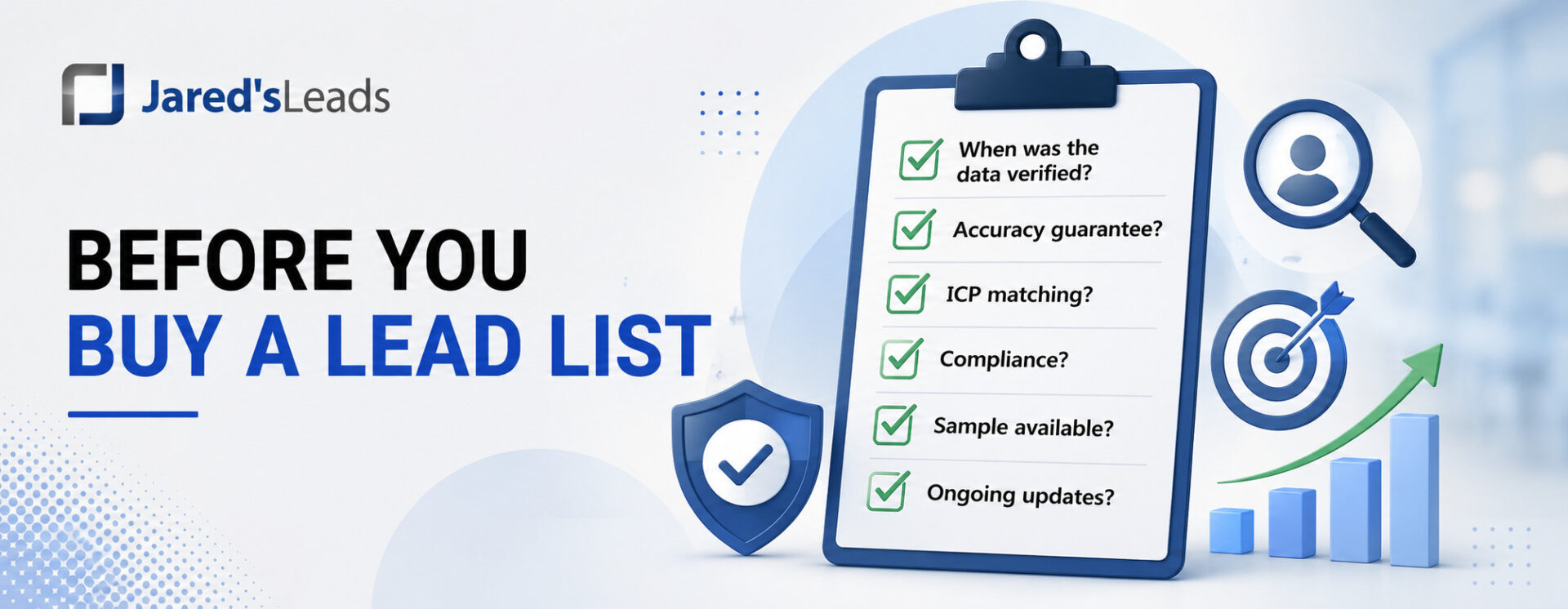
- Sample records that closely match your Ideal Customer Profile rather than generic examples.
- A clear explanation of when each record was last verified.
- A documented schedule for ongoing data verification.
- Compliance practices appropriate for the type of data being purchased.
- An accuracy guarantee or replacement policy for invalid records.
Whenever possible, request a sample before placing an order.
Take a handful of contacts and verify them manually using LinkedIn, the company website, or other publicly available business sources. Confirm the individual’s current job title, employer, business location, and contact details.
A provider that is confident in its data quality should be comfortable supplying sample records and answering questions about its verification process.
If important questions are met with vague answers or unsupported claims, consider it a sign to continue your search.
How Jared’s Leads Builds High-Quality Lead Lists
At Jared’s Leads, data quality begins long before a list is delivered.
Every project starts by understanding the client’s target audience. Rather than relying solely on automated filters, the team works with clients to define important criteria such as industry, company size, job title, geography, and other relevant business characteristics.
Each database undergoes multiple verification steps designed to improve accuracy and reduce invalid records. Depending on the type of data requested, verification may include email validation, mailing address standardisation, National Change of Address (NCOA) processing, CASS certification where applicable, and Do Not Call (DNC) screening for qualifying phone campaigns.
Instead of delivering a generic database, Jared’s Leads builds customised lists designed to support specific marketing objectives, whether that’s direct mail, email marketing, outbound sales, or multi-channel prospecting.
The company also offers data management services to help businesses maintain accurate marketing databases over time. Regular updates and ongoing list maintenance help reduce data decay and improve campaign performance long after the initial purchase.
If replacement records are needed under the company’s data accuracy policy, Jared’s Leads works with clients to resolve eligible issues promptly, providing additional confidence in the quality of the data delivered.
Businesses looking for targeted audiences can also explore Jared’s Leads’ Consumer Mailing Lists, Business Email Lists, Sales Leads, Data Services, and List Management Services to support a wide range of marketing campaigns.
About Jared’s Leads
Since 2008, Jared’s Leads has helped businesses connect with qualified prospects through targeted business and consumer marketing data. The company provides custom mailing lists, email lists, phone lists, and data management services designed to support direct mail, email marketing, outbound sales, and multi-channel campaigns.
Jared’s Leads focuses on data accuracy, audience targeting, and ongoing database maintenance to help clients improve campaign performance and reduce the costs associated with outdated or incomplete contact information.
In addition to marketing data, Jared’s Leads offers LeadWave, its customer relationship management (CRM) and marketing automation platform. LeadWave helps businesses organise leads, manage pipelines, automate follow-up, engage prospects across multiple channels, and monitor campaign performance from a single platform.
Over the years, Jared’s Leads has been recognised on the Inc. 5000 list of America’s fastest-growing private companies and has also been named to the Inc. Regionals: Pacific rankings, reflecting the company’s continued growth and commitment to serving businesses across a wide range of industries.
Whether you’re launching your first outreach campaign or scaling an existing sales programme, Jared’s Leads provides targeted marketing data and the tools needed to build more effective prospecting campaigns.
Frequently Asked Questions
Q.1. What accuracy rate should I expect from a quality lead list?
While no provider can guarantee perfect data, reputable companies regularly verify their databases and stand behind the quality of their records with replacement policies or accuracy guarantees. Ask how the data is validated and how frequently it is updated rather than focusing on a single advertised percentage.
Q.2. How often should a lead list be updated?
Business data changes every day as employees change roles, companies grow, merge, or relocate. Providers that update their databases regularly generally deliver more reliable results than those relying on infrequent verification cycles.
Q.3. Does a larger database mean better data?
Not necessarily. A smaller, carefully maintained database often produces better campaign results than a much larger database with outdated or unverified records. Quality, relevance, and accuracy are far more important than volume.
Q.4. Why does compliance matter when purchasing a lead list?
Compliance helps reduce legal and reputational risk. Depending on your marketing channel and target market, your provider should follow recognised standards and applicable regulations such as GDPR, CCPA, Do Not Call screening, and National Change of Address processing where appropriate.
Q.5. Should I build my own lead list or buy one?
Both approaches have advantages.
Building your own database usually produces highly engaged contacts because prospects have already interacted with your business. Purchasing a verified lead list allows you to reach qualified prospects much faster. The right choice depends on your growth objectives, available resources, and campaign timeline.
Q.6. Can I request a sample before purchasing?
Yes. A reputable provider should be willing to provide sample records that closely match your Ideal Customer Profile. Reviewing sample data allows you to evaluate accuracy, relevance, and overall data quality before making a purchasing decision.
Q.7. Does lead list quality affect email deliverability?
Absolutely. Outdated or inaccurate email addresses contribute to hard bounces, which can negatively affect your sender reputation with providers such as Gmail and Outlook. Using verified, regularly maintained data helps improve deliverability and supports stronger long term email performance.
Final Thoughts
A high-quality lead list is a critical strategic asset that enables your sales and marketing teams to execute outreach with absolute confidence. Before executing a data purchase, always audit how the vendor collects, verifies, and maintains their records.
Partnering with Jared’s Leads who prioritizes field-level accuracy, continuous re-verification cadences, and strict legal compliance drastically cuts down on wasted sales hours while protecting your vital domain reputation.
If you are ready to scale your pipeline with fully compliant, verified business or consumer records tailored to your exact target audience, explore the comprehensive database structures at Jared’s Leads.
From custom mailing lists and verified business email lists to targeted sales leads and data management solutions, our data infrastructure is built to maximize your conversion velocity and drive measurable pipeline ROI.