
Reach Verified Charitable Donors Ready to Give Again
Charitable Donors Delivered in Real Time
- 98%+ Deliverability
- No Minimums
- No Contracts
22M+
Business Records

200M+
Consumer Records
18+
Years in Business
Inc.
5000 Honoree
A+
BBB Rating
NCOA
Processed & DNC-Scrubbed
24/7
Support
Find Donors Who Are More Likely to Give Again
Finding donors who actually care about your cause is harder than ever. Nonprofits, advocacy organizations, and cause-driven brands compete for attention in crowded donor inboxes during overloaded fundraising cycles. Broad outreach burns through the budget fast when the audience is not aligned with the campaign’s mission. In fact, 33% of donors say email is the tool that most inspires them to give, ahead of social media, an organization’s website, and print.[1]
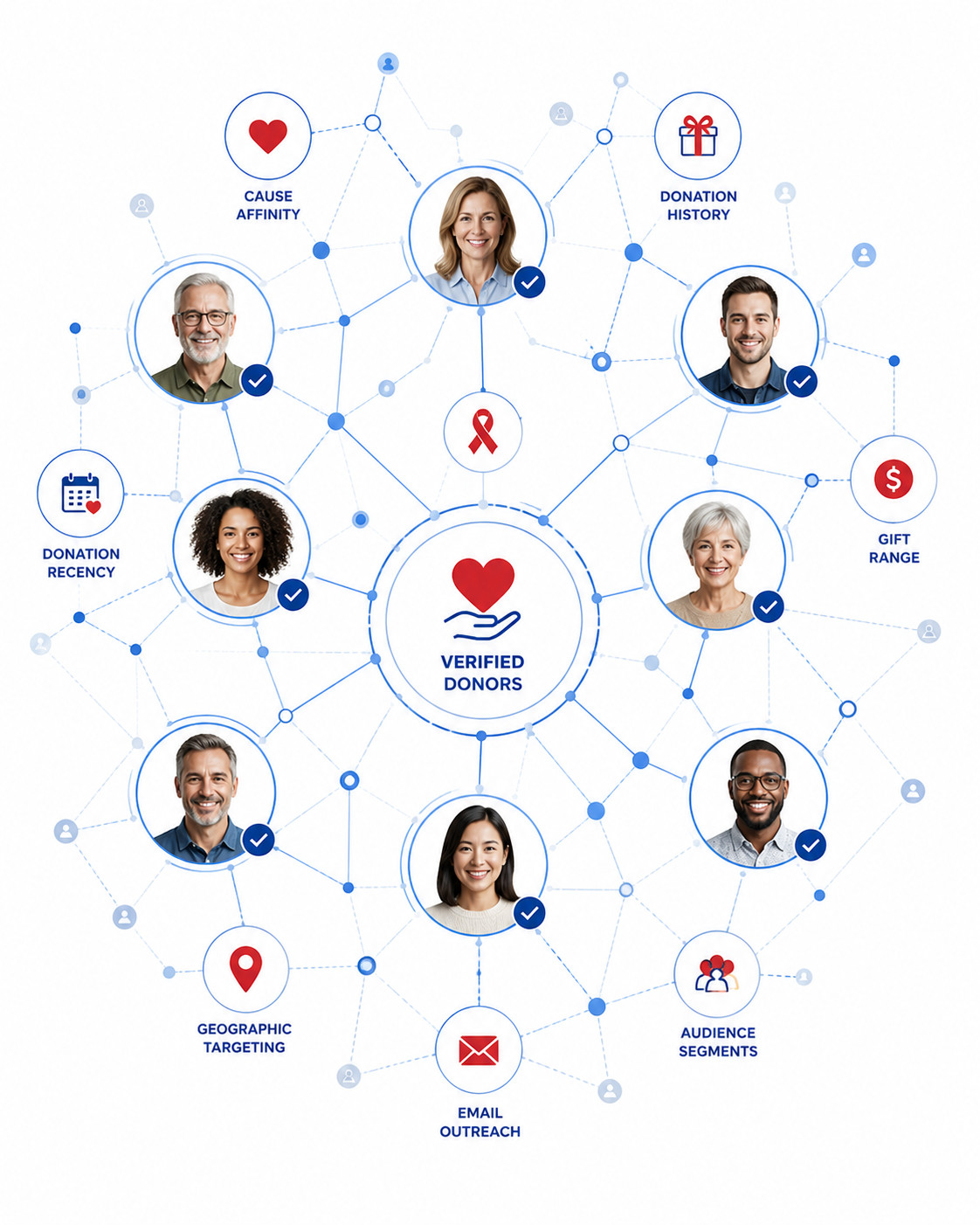
We help organizations reach verified charitable donors with targeted donor email lists filtered by cause affinity, donation recency, gift range, and geography. Instead of blasting generic fundraising audiences, you’ll build outreach to people who are already more likely to respond to your message.
Whether you’re building a nonprofit acquisition campaign, refreshing your donor file, promoting a fundraising event, or coordinating a multi-channel cause marketing effort, you’ll work with real data specialists to build an audience that fits your goals.
- Reach consumers with a verified history of donating to charities, causes, and nonprofits.
- Filter by cause affinity, gift size, donation frequency, and geography.
- Delivered in CSV or spreadsheet format compatible with your CRM or email platform.
- Custom-scoped donor audiences built for your campaign, not generic files muddied with unrelated data.
We’ve built our reputation on doing the work the right way: combining decades of experience, responsive support from real people, and carefully scoped data that fits your campaign. Clients trust our team because the process is straightforward, the guidance is practical, and the focus stays on relevance, compliance, and results.
Buy a Targeted Donor Email List
Charitable donors are often a strong fundraising audience because they have already demonstrated a willingness to give.
That is the difference between a broad charity email list and targeted fundraising.
A recent healthcare donor is more likely to respond to a medical fundraising campaign than a cold consumer audience with no charitable history. The same applies to environmental donors, veteran supporters, religious contributors, and humanitarian giving audiences. Relevance matters for a charity’s donor email list.
That is also why donor list quality matters.
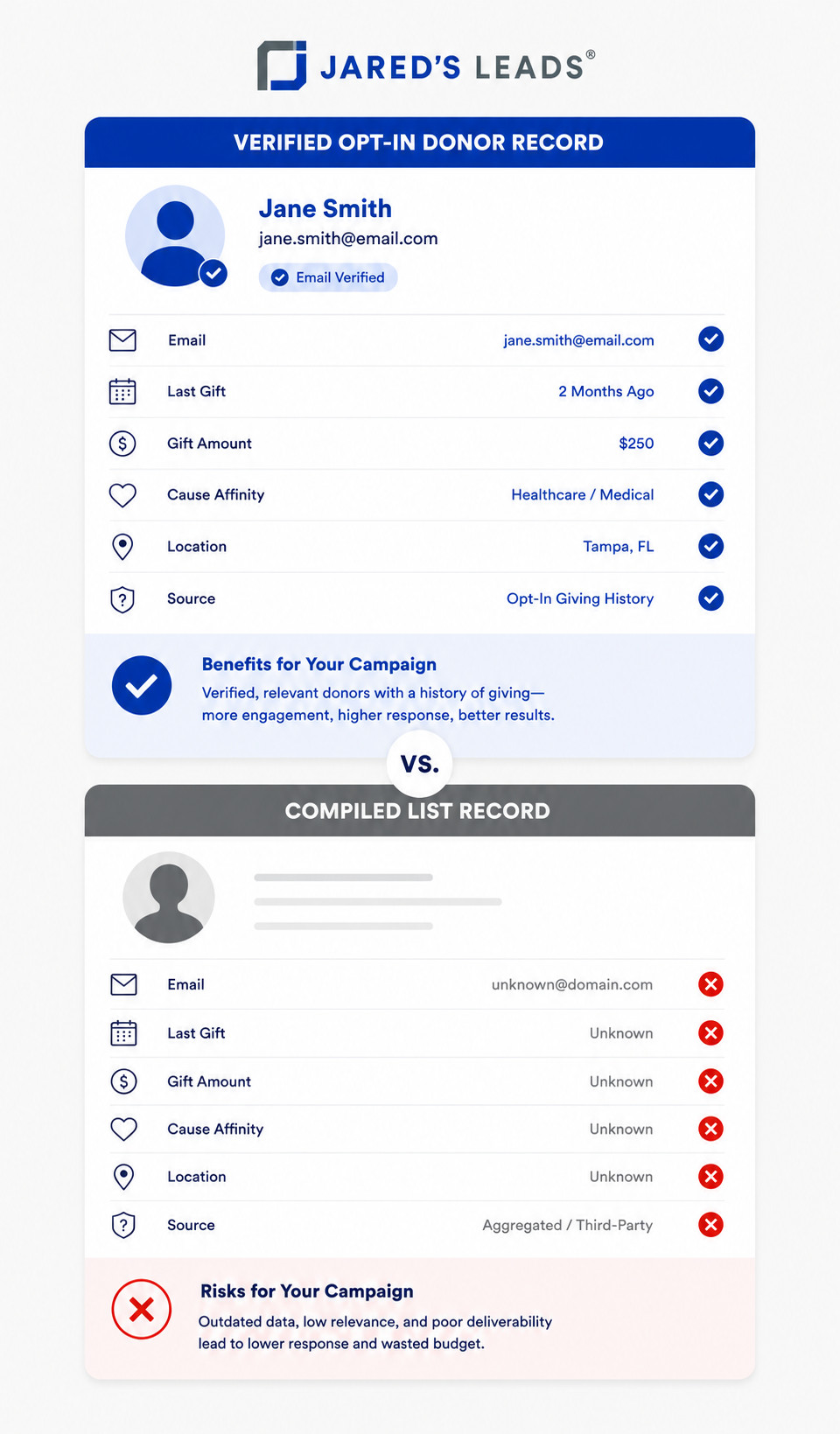
Usually, a charitable donor email list is outdated, unverified, or pulled from public political contribution records rather than actual charitable donor audiences. Others combine unrelated donor categories, which weakens campaign alignment and lowers outreach quality.
Our donor lists are built from opt-in giving history, NCOA-updated, and filtered to remove political, medical, and non-charitable records. Available filters may include cause category, donation frequency, recency of last gift, geographic targeting, estimated income range, and giving behavior indicators, depending on the selected segment.
Count estimates are available before ordering, so your team can evaluate audience size and campaign scope before committing a budget.
What Is a Donor Email List?
A donor email list is a curated set of consumer contact records tied to individuals with a documented history of charitable giving.
These audiences are commonly used by nonprofits, fundraising organizations, advocacy groups, charities, and cause-marketing campaigns looking to reach consumers already engaged in charitable activity. Email continues to deliver for these organizations: nonprofits raised an average of $54 for every 1,000 fundraising emails sent in 2025, and email revenue grew 16% year over year.[2]
Our team separates charitable donor audiences from unrelated donor categories, enabling organizations to build more focused outreach campaigns. We can narrowly target a charity email list without mixing in political donor records, organ donor registries, or nonprofit employee directories.
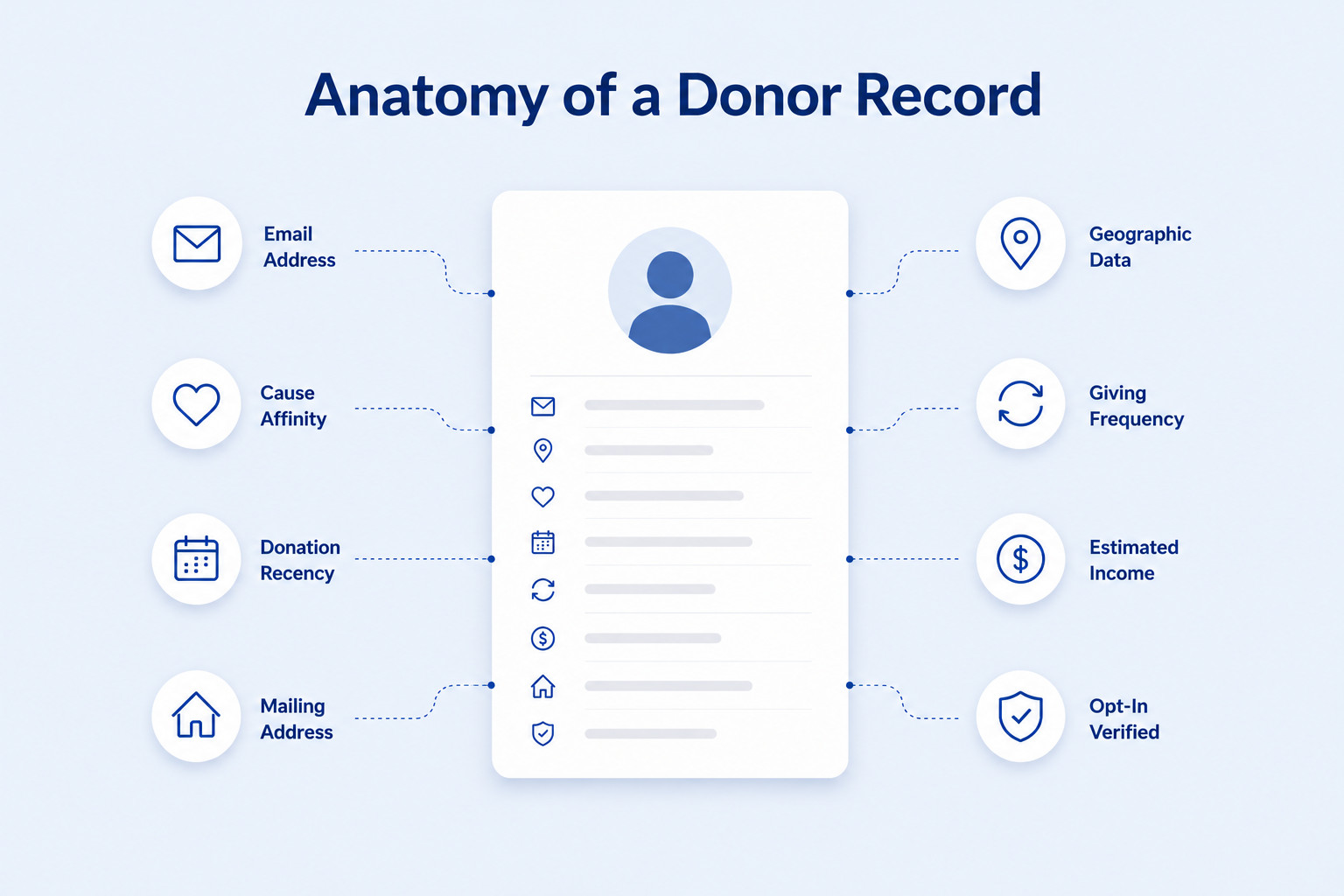
Depending on the segment and available fields, donor contact records may include donors email addresses, mailing addresses, geographic data, estimated income ranges, donation recency, giving frequency, and cause affinity indicators.
Why Recency of Giving and Cause Alignment Matter
One of the best signs that someone may respond again is how recently they made a charitable contribution. The data backs this up: only 14% of first-time donors ever make a second gift, while prior donors return at a rate of 66%.[3] Reaching donors while they are still in the active giving cycle is one of the most important factors in fundraising response.
30-Day Window
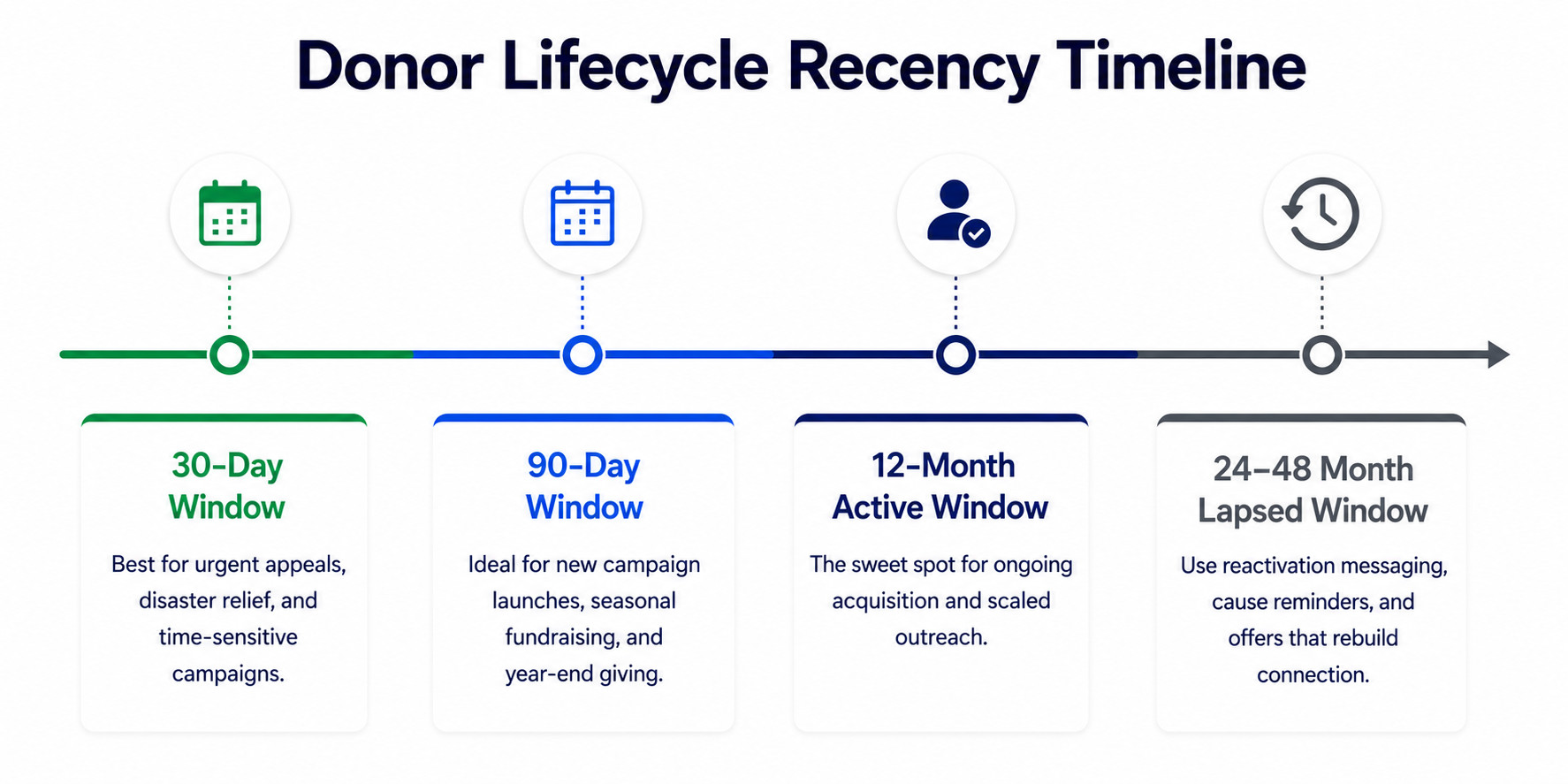
Donors who gave within the last 30 days are often the best fit for urgent appeals, disaster relief, and time-sensitive campaigns. They’re most likely to be emotionally connected to a cause and responsive to a timely request.
90-Day Window
The 90-day window works well for new campaign launches, seasonal fundraising, and year-end giving. It captures donors who are still relatively fresh in the cycle but may be ready for a second engagement touch.
12-Month Active Window
24 to 48 Month Lapsed Window
Lapsed donors can still be worth reaching, but they should not be treated like active donors. This group usually responds best to reactivation messaging, cause reminders, or offers that rebuild connection before asking for another gift.
More refined donor segmentation helps organizations align campaign strategy with donor lifecycle stages rather than relying on generic mass solicitation.
Why Broad Fundraising Outreach Often Underperforms
Most donors already receive fundraising emails, direct mail appeals, social campaigns, and donation requests from multiple organizations every month. When the audience is too wide, donors tune out.
Donor Fatigue
Cause Alignment
Trust & Stewardship
[Donor]
Types of Donor Audiences
Different charitable causes attract different donor behaviors, priorities, and engagement patterns. Generalized donation lists rarely perform as well as cause-aligned audience targeting. Demographics matter when aligning a cause with an audience: roughly 67% of U.S. donors are female.[4]
Your list of donor emails may be segmented by charitable interest category, demographic profile, donation behavior, geography, and campaign focus, depending on the selected audience.
Healthcare Donors
Healthcare donor audiences may include individuals who support hospitals, medical research foundations, disease-awareness campaigns, and patient advocacy organizations.
These audiences are commonly used for medical fundraising campaigns, healthcare advocacy outreach, hospital foundation development, and disease research initiatives.
Religious Donors
Religious donor audiences may include church contributors, ministry supporters, faith-based giving audiences, and donors active in religious nonprofit outreach.
Faith-centered campaigns often perform best when messaging emphasizes mission, service, community impact, and long-term stewardship.
Environmental Donors
Environmental donor audiences may include consumers interested in conservation, sustainability initiatives, and wildlife protection, as well as environmental nonprofit organizations.
Charity lists can often identify these highly engaged audiences who exhibit recurring giving behavior tied to cause-driven outreach.
Arts & Education Donors
Arts and education donor audiences may include museum supporters, scholarship contributors, university donors, performing arts patrons, educational nonprofit supporters, and public media contributors.
These audiences often demonstrate strong recurring giving behavior and are frequently concentrated within metro markets. Emails for donations targeting these audiences can often outperform.
Animal Welfare Donors
Animal welfare donor audiences may include supporters of rescue organizations, humane societies, wildlife rehabilitation groups, and animal advocacy campaigns.
Audience alignment is crucial in this category because donor engagement is often emotionally tied to highly specific causes.
Political Donors
Political donor audiences may include campaign contributors, advocacy organizations, grassroots fundraising initiatives, and public policy groups.
These records are distinct from charitable donor audiences and involve different sourcing and compliance considerations. Jared’s Leads separates these categories to improve targeting clarity and campaign relevance.
Veterans & Military Donors
Veterans and military donor audiences may include supporters of veteran assistance programs, military family charities, wounded veteran organizations, and patriotic nonprofit causes.
These audiences often respond well to outreach focused on service, support, and mission-driven impact.
Multi-Channel Donor Outreach
Modern fundraising campaigns rarely rely on a single communication channel anymore.
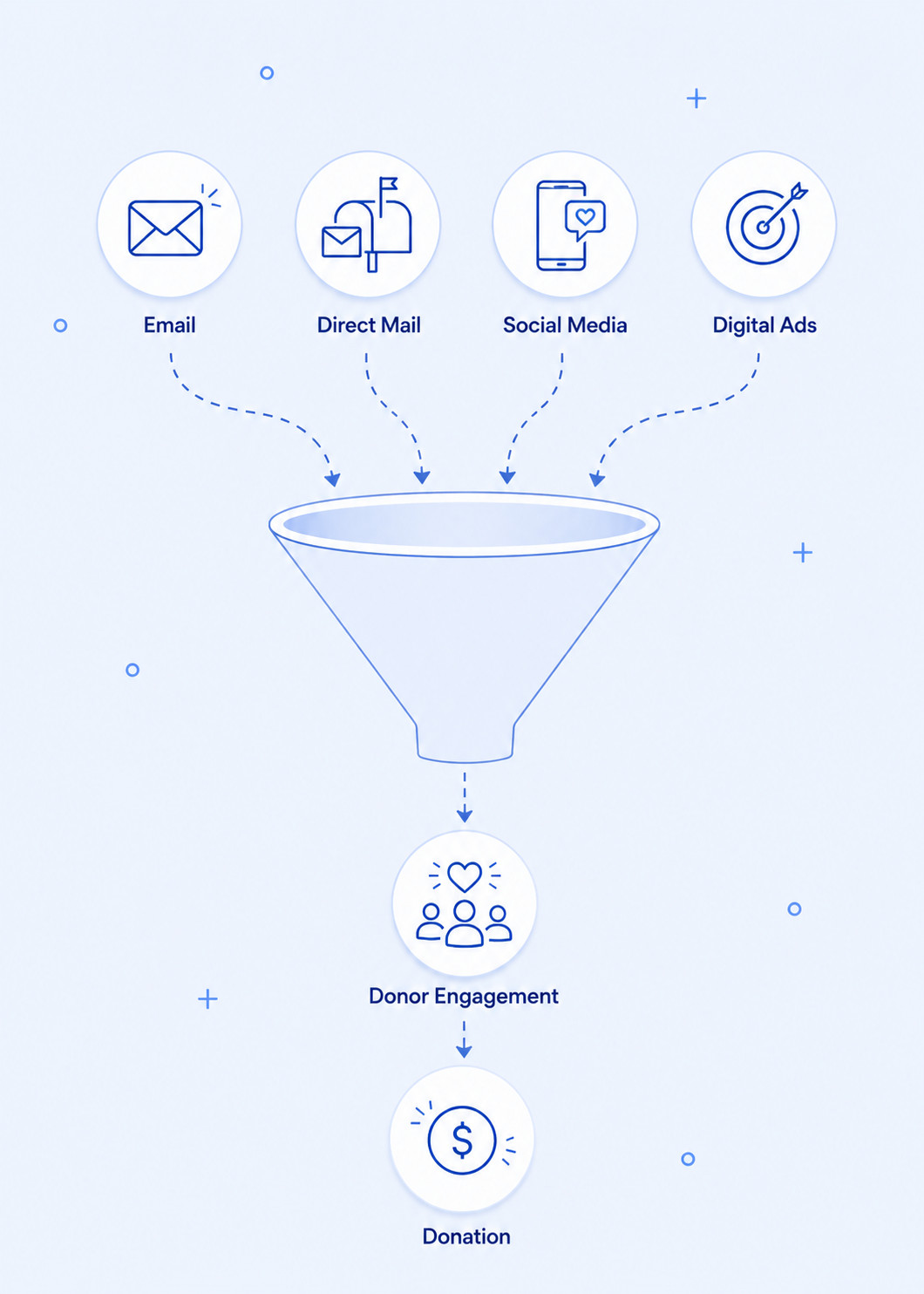
Donors interact with organizations through email, direct mail, digital advertising, social media, fundraising events, and CRM remarketing campaigns. Organizations that rely too heavily on a single outreach channel often struggle to maintain visibility without oversoliciting supporters.
More coordinated donor outreach strategies help reinforce campaign messaging while allowing supporters to engage through the channels they naturally prefer.
Direct Mail Still Performs Strongly in Charitable Giving
Despite the growth of digital fundraising, direct mail remains a major part of donor acquisition and recurring giving campaigns, especially among older donor demographics and long-established charitable audiences.
Physical fundraising appeals often create a stronger sense of legitimacy and permanence than digital outreach alone. Many organizations continue using donor mailing lists for fundraising appeals, membership campaigns, event promotion, donor reactivation, and planned giving outreach.
Social Media & Digital Reinforcement Improve Campaign Visibility
Many nonprofits coordinate donor outreach across email, social media, digital advertising, and remarketing campaigns to reinforce visibility without relying entirely on repeated fundraising emails.
Digital audience activation formats may be available for Meta Ads Custom Audiences and Google Customer Match, allowing organizations to extend donor outreach beyond traditional email campaigns.
Digital Audience Activation Note
Donor contact records from Jared’s Leads can be formatted for Meta Ads Custom Audiences and Google Customer Match, enabling digital retargeting to verified charitable donors alongside postal and email outreach. Multi-touch campaigns that combine direct mail and digital consistently improve response rates compared to single-channel approaches. Format matters too: including video in fundraising emails can boost click-through rates by 65%, and 53% of emails are now opened on a mobile device.[5]
Organizations Using Donor Email Lists by Industry
A wide range of mission-driven organizations use donor email lists, but the best segmentation depends on the campaign’s goals. A nonprofit raising funds for a local program does not need the same audience structure as a DTC brand trying to reach values-driven consumers.
Nonprofits
Nonprofits use donor email lists to find new supporters based on recency, geography, and cause affinity. The size of a nonprofit’s email list is secondary to targeting.
Health

Environmental
Environmental organizations use donation lists to connect with people who care about conservation, sustainability, wildlife protection, and climate-related causes. These audiences often respond well to recurring fundraising appeals because they tend to support multiple organizations.
Humanitarian
Humanitarian groups often need donor audiences that are broad enough to scale but still tied to a meaningful cause. Donor email lists help these organizations reach people who have already shown interest in poverty relief, disaster response, food insecurity, refugee support, and similar efforts.

Religious

Arts & Education
Arts, culture, and education organizations often benefit from donor audiences that overlap with membership, philanthropy, alumni support, and patron giving.
Cause Marketing DTC Brands
Cause marketing brands and mission-led DTC companies often use donor-style audiences because those consumers have already demonstrated values-driven behavior.
Donor List Targeting Options and Data Attributes
Targeting flexibility is one of the biggest differences between a generic donor file and a campaign-ready donor audience. More refined donor segmentation helps organizations reduce wasted outreach while improving audience relevance and fundraising efficiency.
Cause Affinity Filters
Donor audiences may be segmented by charitable interest category depending on the available dataset and campaign scope.
Available cause-affinity categories may include:
- Health and medical causes.
- Environmental and conservation causes.
- Humanitarian and poverty relief.
- Religious and faith-based causes.
- Children and youth causes.
- Arts, culture, and education.
- Animal welfare and wildlife.
Giving Behavior Filters
Donor giving behavior is often one of the strongest predictors of fundraising responsiveness. Available filters may include donation recency, estimated gift range, donation frequency, and multi-cause giving behavior, depending on the segment selected.
Donor Recency Filters
Recency remains one of the most important variables in donor campaign performance.
Donors active within the last 30 to 90 days are generally still operating in an active-giving mindset, while lapsed donors often require different messaging and reactivation-focused outreach. Gift ranges and affinity scores further categorize donor emails. Campaign strategy usually performs best when the donor lifecycle stage matches the fundraising objective.
Demographic Filters
- ZIP code, city, county, or state targeting.
- DMA and metro-area targeting.
- Radius targeting around a location.
- Estimated household income.
- Age range.
- Gender.
- Homeownership indicators.
Delivery and Format
Donor contact records are commonly delivered in CSV or spreadsheet format compatible with major CRM and email marketing platforms, including Mailchimp, HubSpot, Klaviyo, Constant Contact, and ActiveCampaign.
Depending on the segment selected, available fields may include donor name, email address, mailing address, ZIP code, cause affinity category, estimated income range, gift-range indicators, and donation recency signals.
Digital audience activation formats may also be available for Meta Ads Custom Audiences and Google Customer Match.
CASS Certification and Address Hygiene
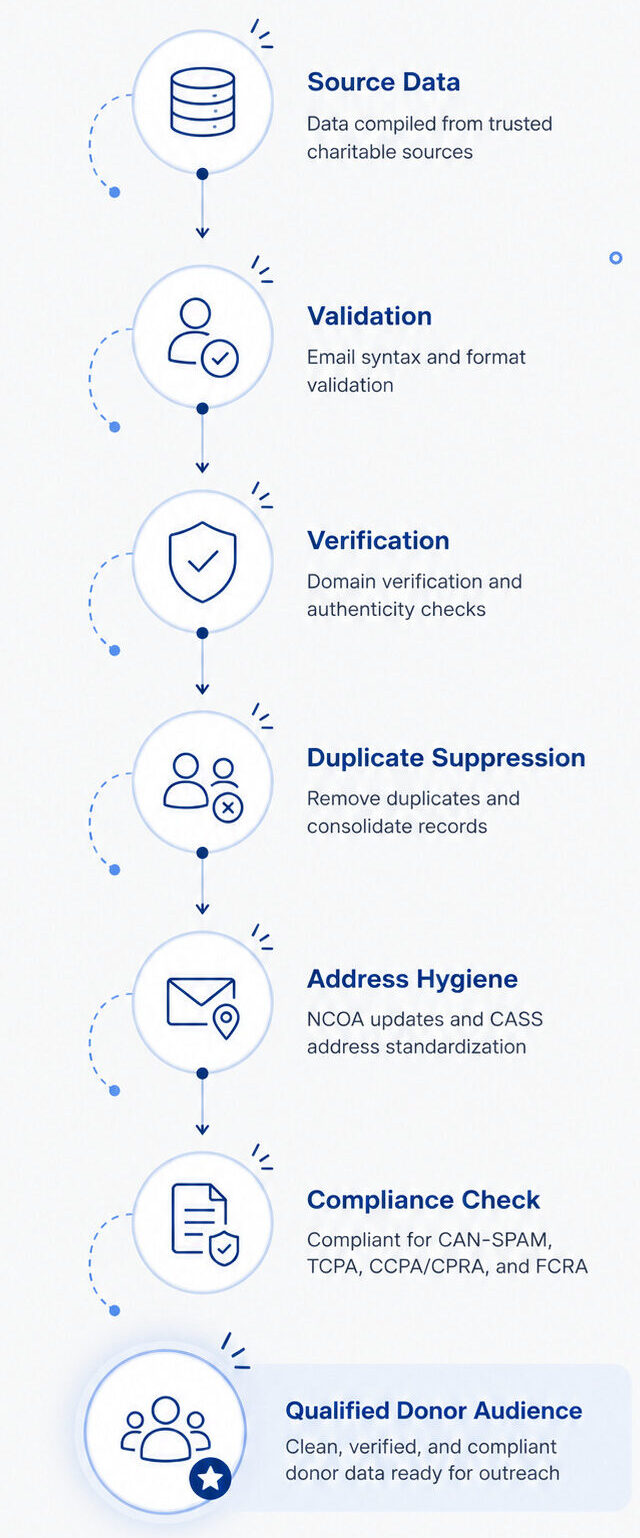
Where mailing addresses are included, donor records may be CASS-certified and processed through NCOA hygiene updates to improve postal deliverability and reduce wasted direct mail spend.
CASS certification standardizes address formatting according to USPS requirements, while NCOA processing helps identify recent address changes and forwarding updates.
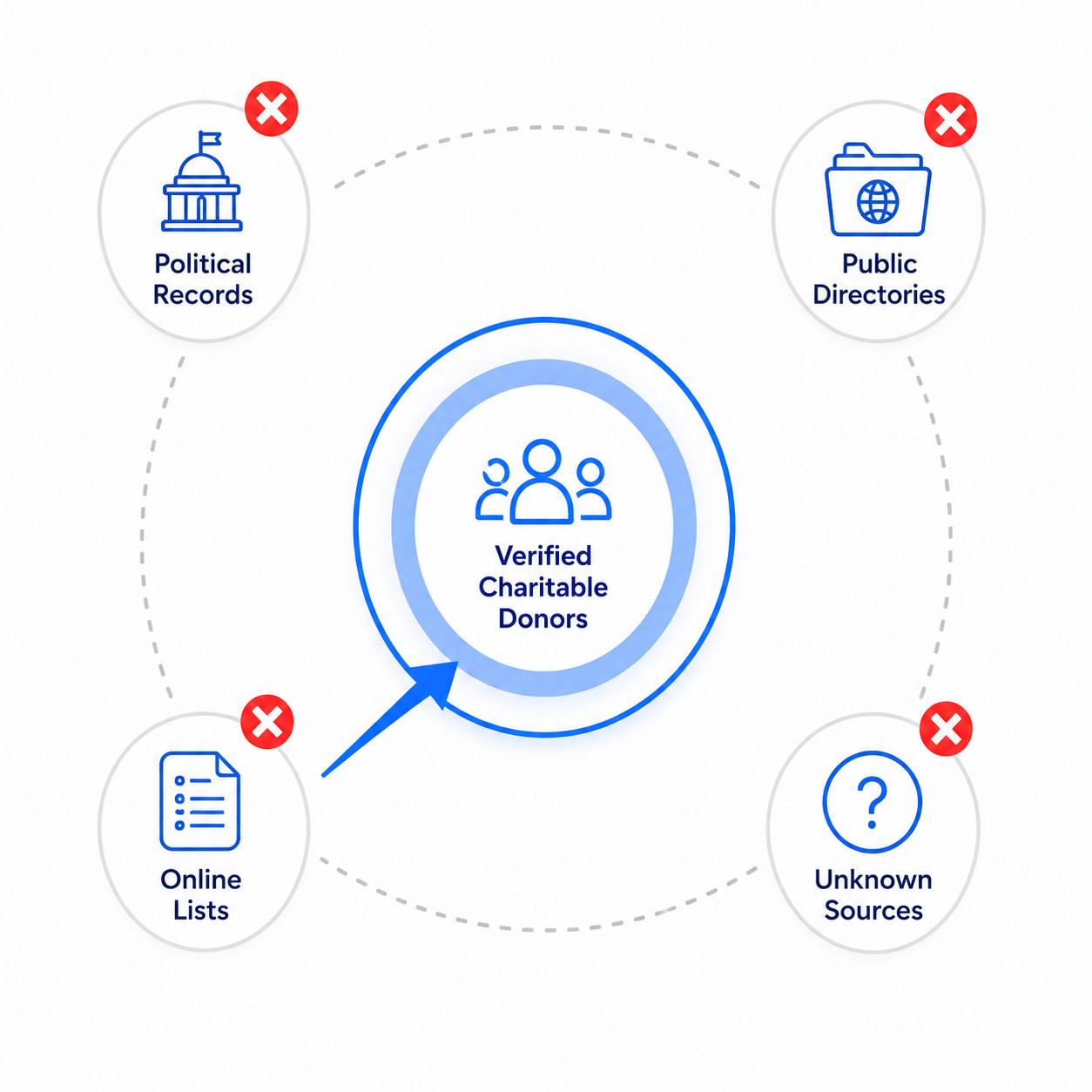
Why Free Donors Email Lists Miss the Mark
Searches for free donor email lists often lead to low-quality or misleading data sources.
In many cases, these lists are actually political donor records pulled from public campaign finance filings rather than verified charitable donor audiences. Others are outdated extracts compiled from nonprofit annual reports or miscellaneous online directories with little validation or segmentation.
That creates a major quality problem.
Free donor lists found online often mix charitable donors, political contributors, and unrelated public records without clear sourcing or audience segmentation. The result is weaker targeting, lower campaign relevance, and more compliance concerns. Poor targeting is costly: acquiring a new donor runs roughly five times more than retaining an existing one, so reaching the right audience the first time protects your budget.[6]
Jared’s Leads donor contact records are built for charitable outreach campaigns and may include filtering for cause affinity, geography, giving behavior, and recency, depending on the selected audience.
Donor List Data Quality and Compliance
Data quality matters in fundraising outreach because poorly matched donor audiences create wasted outreach, weaker engagement, and lower long-term campaign efficiency.
Jared’s Leads positions donor audience quality around verified sourcing, audience relevance, and campaign alignment, rather than on inflated claims of perfection or guaranteed outcomes.
Data Verification Processes
Donor contact records may be compiled from charitable giving surveys, fundraising response history, charitable platform registrations, and cooperative data environments used within nonprofit outreach modeling.
Available quality-control processes may include email syntax validation, domain verification, duplicate suppression, address hygiene processing, and data refresh cycles designed to reflect current contact activity where available.
Where mailing addresses are included, records may be processed through NCOA updates and CASS address standardization workflows to improve postal deliverability.
Compliance Considerations
Donor contact records from Jared’s Leads are intended solely for marketing and outreach purposes.
Organizations using a charity donors email list remain responsible for ensuring their campaigns comply with applicable federal and state regulations, including CAN-SPAM requirements for commercial email outreach.
Where phone data is included as an add-on field, outreach campaigns should comply with applicable TCPA and Do Not Call requirements.
California privacy considerations, including CCPA and CPRA obligations, may also apply depending on the campaign and audience geography.
FCRA Compliance Note
B2C Donor Lists vs. B2B Nonprofit Lists
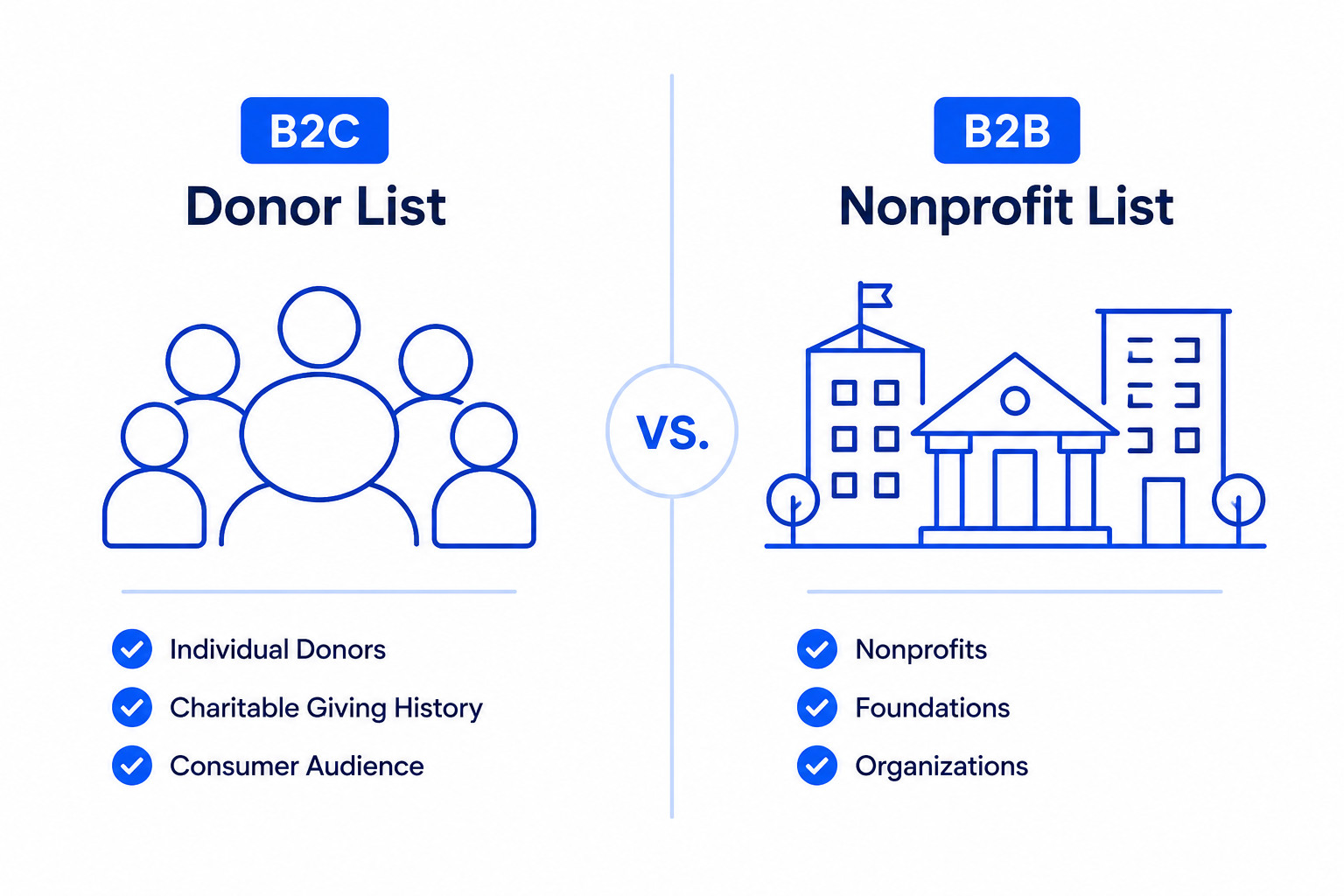
A B2C donor list contains individuals with a documented history of charitable giving. A B2B nonprofit list contains organizations, foundations, charities, or other institutional entities that represent a completely different audience, data structure, and intent.
That distinction matters because many vendors blur the line between consumer donors and nonprofit organizations. When your nonprofit email list is wrong, your campaign typically performs poorly.
How to Choose a Donor Email List Provider
Choosing a donor email list provider is mostly about trust, clarity, and fit. The best provider should be able to explain what donor data is included, how the audience is segmented, and how the list supports your campaign goals.
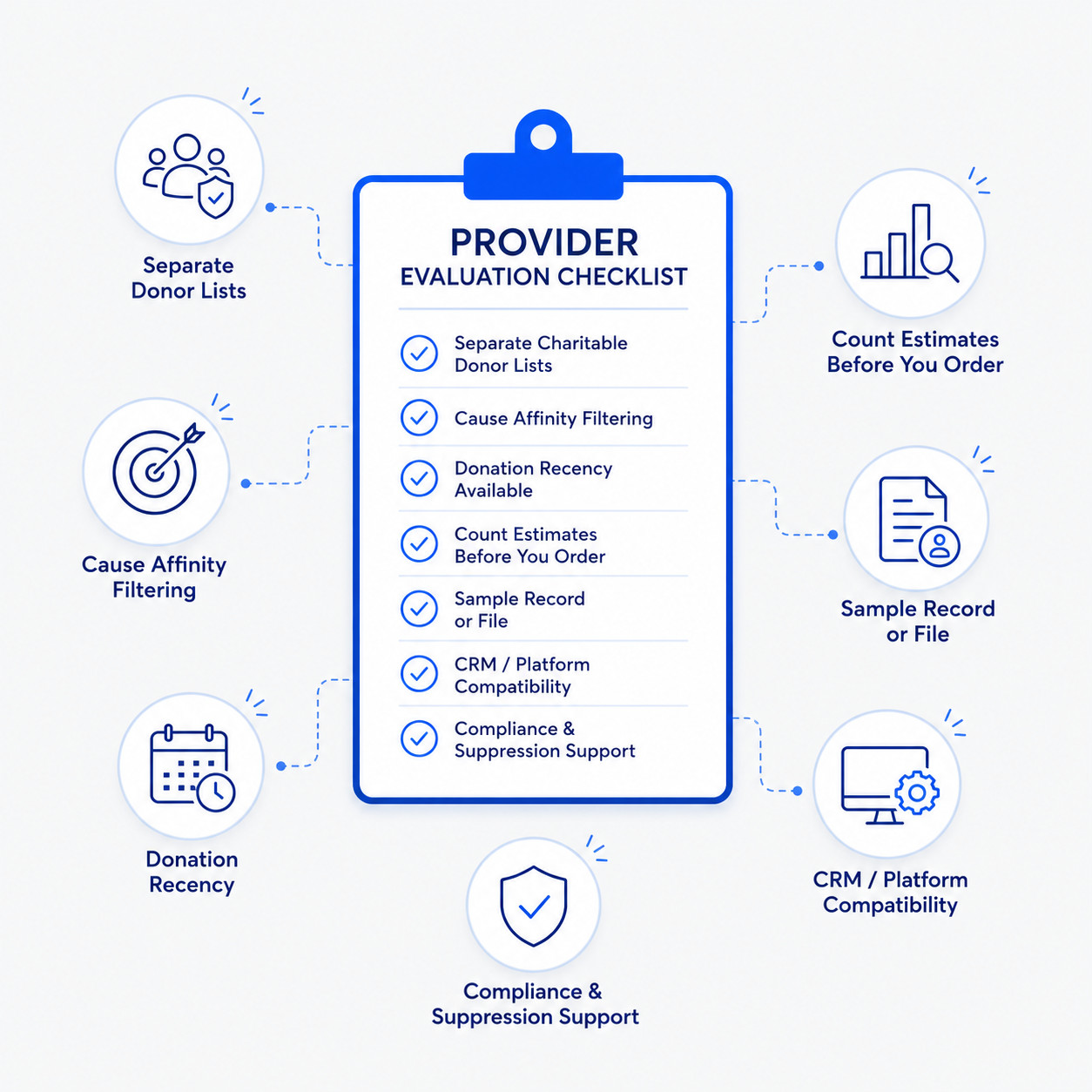
A good provider should be able to answer these questions clearly:
- Does the provider separate charitable donor lists from political donor lists, organ donor records, and unrelated datasets?
- Can you filter by cause affinity, not just geography and demographics?
- Is donation recency available as a filter?
- Are count estimates available before you order?
- Can you review a sample record or sample file?
- Is the list delivered in a format that works with your CRM or email platform?
- Does the provider support compliance-conscious outreach and suppression compatibility?
Why Choose Jared's Leads
Many competitors lead with raw counts and dry language. We pair what matters, donor intent and donor recency, to focus on what you actually need.
What sets us apart is the combination of human support, campaign fit, and clear data, with an upfront ordering process. Buyers can request counts before ordering, review the available audience structure, and get help choosing the segment that best fits their goal.
We built our business around the idea that donor campaigns work better when the list, the message, and the cause are aligned.
Ready to Build Your List?
Start reaching your ideal customers today. No minimums, no contracts.
[FAQs]
Frequently Asked Questions
Have a question about Jared’s Leads and our lists? Let us help!
Request Your Donor Email List.
If your organization needs a more targeted fundraising audience, we can help you build a donor email list aligned with your campaign goals, geography, and cause focus.
Available segmentation may include:
- Cause affinity.
- Donation recency.
- Estimated gift range.
- Geographic targeting.
- Donation frequency.
- Household income indicators.
Donor contact records may be delivered in CSV or spreadsheet format and can include email, postal, or multi-channel delivery depending on campaign requirements.