
Insurance Leads from Active Coverage Shoppers
Insurance Leads Delivered in Real Time
- 98%+ Deliverability
- No Minimums
- No Contracts
22M+
Business Records

200M+
Consumer Records
18+
Years in Business
Inc.
5000 Honoree
A+
BBB Rating
NCOA
Processed & DNC-Scrubbed
24/7
Support
Custom Insurance Lead List
Insurance leads are verified contact records of consumers who have expressed interest in purchasing a specific insurance product, such as life, health, auto, or homeowners coverage, enabling agents to reach pre-qualified prospects rather than cold audiences.
These leads are tied to active insurance-shopping behavior, helping agencies connect with consumers who are already researching policies rather than relying solely on outbound prospecting.
With Jared’s Leads, you’ll get filtered insurance leads built around your vertical, territory, and exclusivity goals, including:
- Verified consumer insurance leads across life, health, auto, homeowners, commercial, Medicare, and final expense categories.
- Exclusive and shared lead options available based on budget and conversion goals
- Geographic and demographic filtering by state, ZIP code radius, age range, homeowner status, and more
- Real-time, aged, live transfer, direct mail, and telemarketing delivery formats available

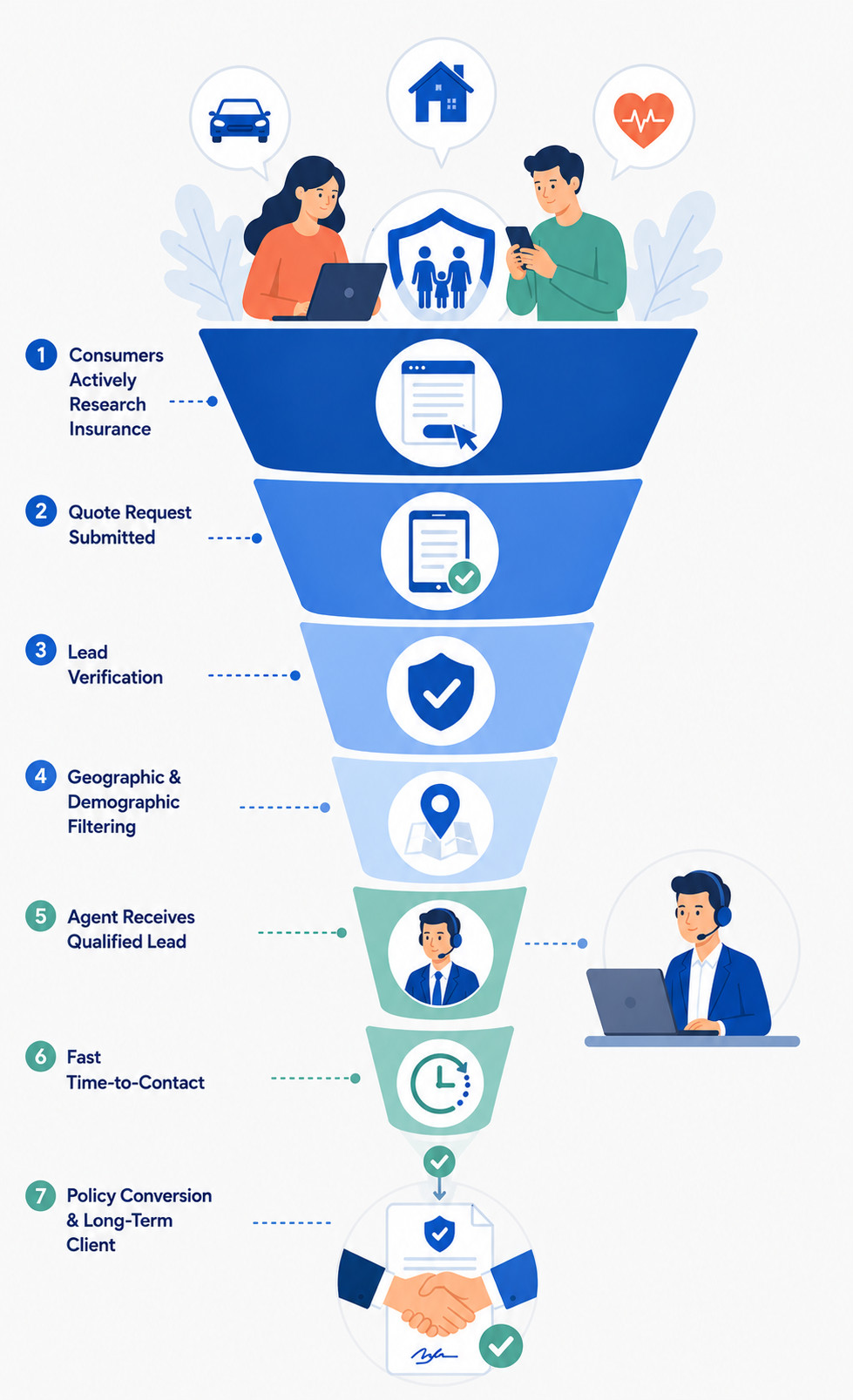
What Makes an Insurance Lead High-Intent?
Insurance leads are verified consumer contacts generated from people actively researching or requesting insurance coverage. These leads help agents and brokers connect with consumers who are already comparing policy options rather than relying entirely on cold outreach.
Unlike broad marketing lists, high-intent insurance leads come from consumers who have recently requested quotes, completed comparison forms, or demonstrated active online shopping behavior. Factors such as lead recency, policy-specific targeting, geographic alignment, and filtering accuracy all play a major role in conversion potential. This shift toward self-directed research is now the norm: more than 70% of consumers begin their insurance search online before ever speaking with an agent.[1]
Quote intent reflects how actively a consumer engages in the insurance-buying process. People comparing premiums, requesting estimates, or researching policy features are often much more responsive than audiences without recent shopping activity.
Insurance buying behavior also varies by coverage type. Auto insurance shoppers can compare several quotes in minutes, while life insurance consumers often take longer to research options before speaking with an agent. Understanding those timelines can help you align your outreach with the way consumers naturally shop.
Lead recency is another important factor. Consumers contacted shortly after submitting a quote request are typically more engaged because insurance research is still top of mind. As leads age, successful conversion often depends on thoughtful follow-up and consistent multi-touch communication.
Why Agents Buy Insurance Leads Instead of Building Everything In-House
Building insurance prospect pipelines internally often requires significant ongoing investment in advertising, landing pages, CRM systems, marketing automation, and audience targeting. When you buy insurance leads, you help supplement your referral pipelines, stabilize lead flow, and connect your agency with consumers who are already researching coverage.
Well-filtered insurance lead data also helps you narrow your outreach by geography, product type, and consumer profile, reducing the time you spend reaching out to poorly matched prospects and improving the overall efficiency of your campaign.
Time-to-Contact: Why Lead Sourcing Speed Matters
Insurance shoppers often look at multiple providers in a short period of time. Because response rates can drop quickly after they submit a quote request, delivering leads quickly helps you connect with consumers while they’re still actively considering their options.
Cost-Per-Lead vs. Cost-Per-Acquisition: What Agents Actually Compare
The lowest-cost lead source doesn’t always deliver the best long-term results, and better-targeted insurance leads often raise your contact rates and conversion efficiency. That reduces wasted outreach and lowers your overall acquisition costs.
Why Many Insurance Leads Fail to Convert
Oversaturated shared leads, stale records, poor geographic alignment, and broad, untargeted audiences often result in outreach efforts that fail to drive policy sales. Consumers shopping for one insurance product may receive irrelevant offers from multiple agents simultaneously, which lowers their trust and increases competition.
Slow response timing is another major contributor to poor lead performance, as insurance shoppers who requested quotes hours or days earlier may already have selected another provider or stopped actively researching coverage. Additionally, lead volume alone doesn’t guarantee stronger results.
Why Insurance Shopping Creates Friction for Consumers
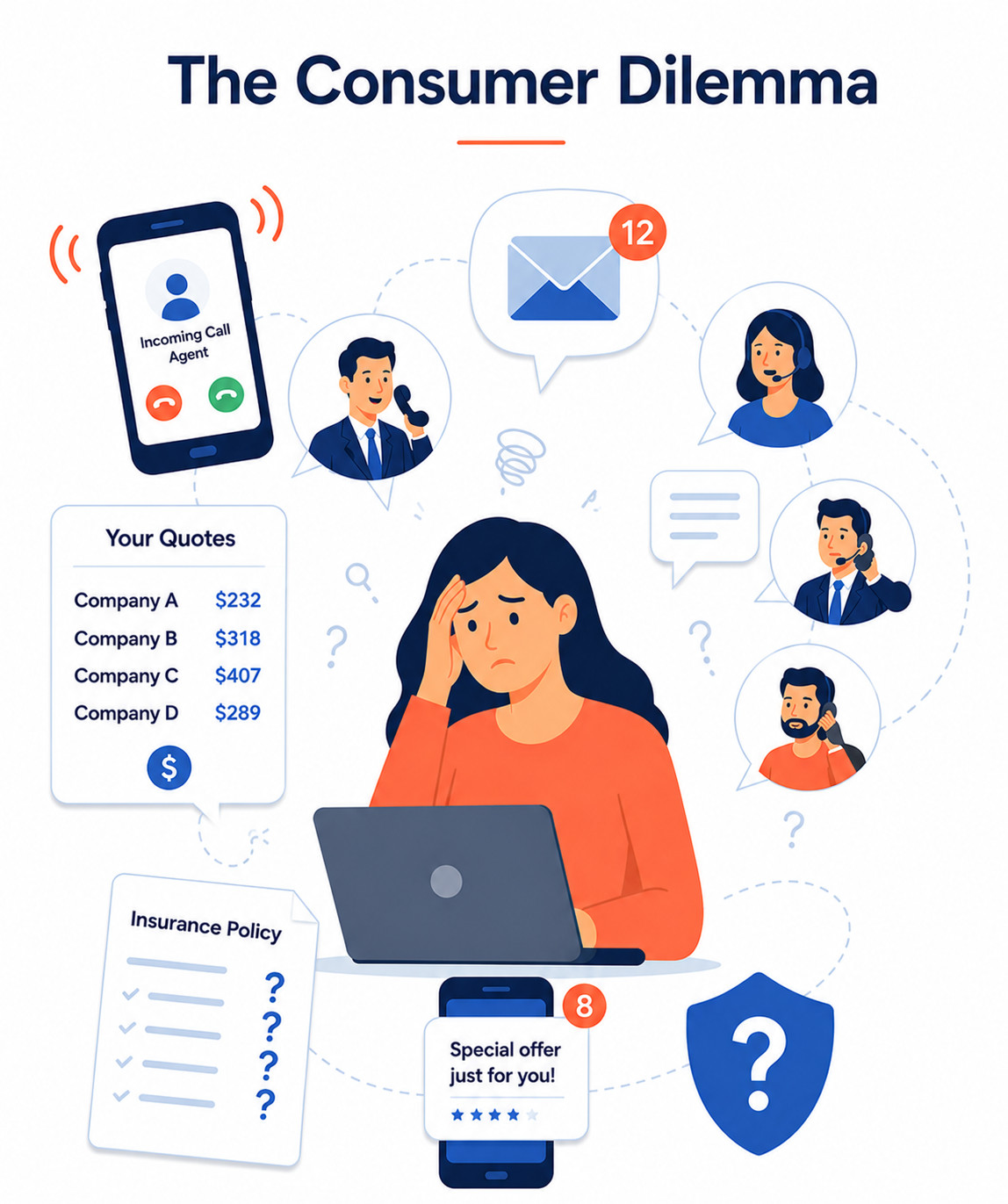
Insurance shopping can be frustrating for consumers because they encounter repetitive forms, aggressive outreach, inconsistent pricing explanations, and overwhelming amounts of information immediately after requesting a quote.
As soon as a consumer submits a comparison request online, they receive calls, emails, and text messages from multiple agencies competing for their attention. Jared’s Leads focuses on more refined filtering and intent alignment to support outreach that feels more relevant and less intrusive. By narrowing targeting around actual policy interest, geography, and consumer behavior, you can create a more efficient experience for both buyers and your insurance professionals.
Insurance Shoppers Often Receive Too Much Generic Outreach
Several agents frequently contact consumers within minutes of submitting an online insurance quote form. Many receive repeated outreach, unrelated policy offers, and high call volumes that are disconnected from their actual coverage interests.
More precise targeting helps you align your outreach with the consumer’s insurance category, location, and stage within the buying journey. Better filtering of insurance leads for agents also reduces unnecessary overlap and creates more relevant conversations.
Pricing Complexity Creates Consumer Distrust
Insurance pricing can vary dramatically between providers, leaving consumers confused about premiums. That final pricing is influenced by:
- Underwriting criteria
- Policy structures
- Discounts
- Eligibility rules
- Coverage limits
Without clear explanations, many consumers perceive insurance pricing as inconsistent or misleading. More policy-specific outreach helps connect shoppers with agents like you who are aligned with their specific coverage needs rather than with broad, one-size-fits-all sales approaches.

Why Insurance Lead Generation Feels Increasingly Competitive
Insurance agencies face growing pressure to maintain consistent prospect volume while managing rising acquisition costs, higher market competition, and tighter response windows. At the same time, if your agency is evaluating lead vendors, you must balance concerns around filtering precision, outreach relevance, operational efficiency, compliance requirements, and consumer engagement timing.
Rising Customer Acquisition Costs
Insurance prospecting costs continue to go up across life, health, auto, homeowners, and commercial verticals. If you’re relying on broad or weakly targeted audiences, you’ll often spend more time qualifying prospects than building meaningful policy conversations. The market is still expanding, which keeps competition high: LIMRA projects new annualized life insurance premium to grow between 2% and 6% in 2026.[2]
Speed-to-Lead Pressure
Insurance shoppers frequently compare multiple providers within a short timeframe, and delayed outreach often results in missed opportunities because consumers either commit elsewhere or stop actively shopping.
Shared Lead Saturation and Outreach Fatigue
Over-distributed insurance leads for sale create frustration for both agencies and consumers. When multiple agents contact the same prospect simultaneously, engagement quality drops while competition rises.
Intent Mismatch and Low-Quality Lead Sources
Different insurance products involve different buying behaviors and qualification standards. If your agency specializes in Medicare, commercial insurance, final expense, or high-risk auto coverage, you often require more refined targeting to avoid irrelevant outreach.
Verification, Consent, and Filtering Standards
Lead verification, geographic filtering, and duplicate suppression help improve outreach quality while reducing wasted operational effort, and better filtering also helps agencies align campaigns with licensing requirements and consumer intent.
[Lead Type]
Insurance Leads by Coverage Type
Different insurance products involve different buying timelines, outreach strategies, and consumer profiles. When you filter by insurance category, you align campaigns with the audiences most relevant to your products and sales process.
Health Insurance Leads
Health insurance leads include consumers researching ACA marketplace plans, Medicare Advantage, Medicare Supplement, short-term health coverage, and employer-sponsored group plans.
Because enrollment behavior follows seasonal cycles, timing and coverage-specific targeting heavily influence your campaign performance. Filtering by age range, geography, product category, and enrollment window helps you prioritize outreach during active shopping periods.
ACA, Medicare Advantage & Group Health Filtering
ACA marketplace plans, Medicare Advantage, Medicare Supplement, and employer-sponsored group coverage can segment health insurance audiences. More refined filtering helps you align outreach with the enrollment needs and policy categories most relevant to each consumer segment.
Homeowners Insurance Leads
Homeowners insurance leads include new homebuyers, renewal shoppers, and homeowners reevaluating their coverage after refinancing, relocating, or upgrading their property. These life events frequently trigger renewed insurance shopping behavior, making timing and homeowner segmentation important for your campaign relevance. Filtering options include estimated home value, property type, geographic territory, and homeowner status.
New Purchase vs. Renewal Homeowner Targeting
New homebuyers typically need immediate coverage tied to a property closing date, while renewal shoppers reevaluate existing policies before expiration. Both represent valuable opportunities, but their messaging and timing requirements differ significantly.
Commercial Insurance Leads
Commercial insurance leads connect agencies with businesses that are researching BOP, general liability, workers’ compensation, commercial auto, and professional liability policies.
Commercial insurance buying cycles frequently involve multiple stakeholders and longer evaluation timelines, making industry-specific targeting especially important. Filtering by SIC or NAICS classification, company size, business type, and geography helps you prioritize businesses aligned with your underwriting focus.
BOP, General Liability & Workers’ Comp Lead Segmentation
Commercial insurance audiences can be segmented by SIC or NAICS classification, employee size, and policy category, including BOP, general liability, workers’ compensation, and commercial auto. More refined filtering aligns your agency’s expertise with the business’s insurance needs.
Auto Insurance Leads
Auto insurance leads are among the most competitive and fastest-moving segments in insurance marketing. Agencies frequently filter campaigns by:
- Driver profile
- SR-22 filings
- High-risk drivers
- Newly licensed drivers
- Multi-vehicle households
Because consumers often request multiple quotes quickly, response speed and geographic targeting are critical to your campaign performance.
High-Risk, SR-22 & New Driver Segments
High-risk drivers, SR-22 filings, and newly licensed drivers represent specialized insurance segments where you often have greater underwriting flexibility than captive carriers. Targeted filtering helps reduce irrelevant outreach while improving the alignment between consumer needs and your available coverage options.
Life Insurance Leads
Life insurance leads connect you with consumers actively researching term, whole, universal, and final expense policies. Because life insurance decisions often involve larger financial commitments and longer evaluation periods, demographic alignment, timing, and exclusivity play major roles in your conversion performance. Filtering options include age range, homeowner status, income band, geographic territory, and declared policy interest to improve efficiency.
Term Life vs. Whole Life: Targeting by Policy Type
Separating the term life audiences from whole life and universal life shoppers helps reduce mismatched outreach and improve the relevance of your campaign. Filtering by declared policy interest also aligns more prospects with the products you actively specialize in.
Exclusive Life Insurance Leads vs. Shared: ROI Comparison
Exclusive life insurance leads reduce direct competition by delivering the record to your agency only. For higher-value products such as indexed universal life and whole life coverage, exclusivity can improve long-term acquisition efficiency, even with higher upfront lead costs.
Final Expense & Medicare Leads
Final expense and Medicare leads support agencies serving senior insurance markets, where communication preferences, buying behavior, and enrollment timing differ from those of younger consumer segments.
These audiences are commonly segmented by age range, geography, and coverage interest to improve outreach relevance. Direct mail and phone-based communication often perform particularly well within Medicare Supplement and final expense campaigns.
Senior insurance consumers often take a more deliberate approach when evaluating coverage options, particularly when comparing Medicare Supplement, Medicare Advantage, and final expense policies. Many prefer speaking directly with a knowledgeable representative who can explain plan details, eligibility requirements, and coverage differences in a clear and straightforward manner.
Accurate lead filtering helps agencies focus on consumers whose needs align with specific products and service areas. By targeting prospects based on factors such as age, location, enrollment status, and expressed coverage interest, insurance professionals can create more relevant conversations while reducing time spent on unqualified outreach.
Exclusive vs. Shared Insurance Leads
Insurance agencies use both shared and exclusive leads depending on acquisition strategy, staffing capacity, and budget priorities.
1
How Shared Leads Work and When They Make Sense
Shared insurance leads are distributed to multiple agencies and generally cost less than exclusive records. They’re commonly used in high-volume prospecting environments where fast-response systems and consistent follow-up processes support conversion efforts. If your agency can achieve rapid outreach, shared leads can provide scalable prospect volume at a lower upfront acquisition cost.
2
Why Exclusive Leads Produce Higher Close Rates
3
Calculating Your Break-Even Cost-Per-Lead
Many agencies evaluate lead performance based on acquisition cost rather than just lead price. Comparing average commission value against expected close rates helps determine whether higher-cost exclusive leads create stronger long-term profitability.
4
Why Lead Saturation Hurts Both Consumers and Agents
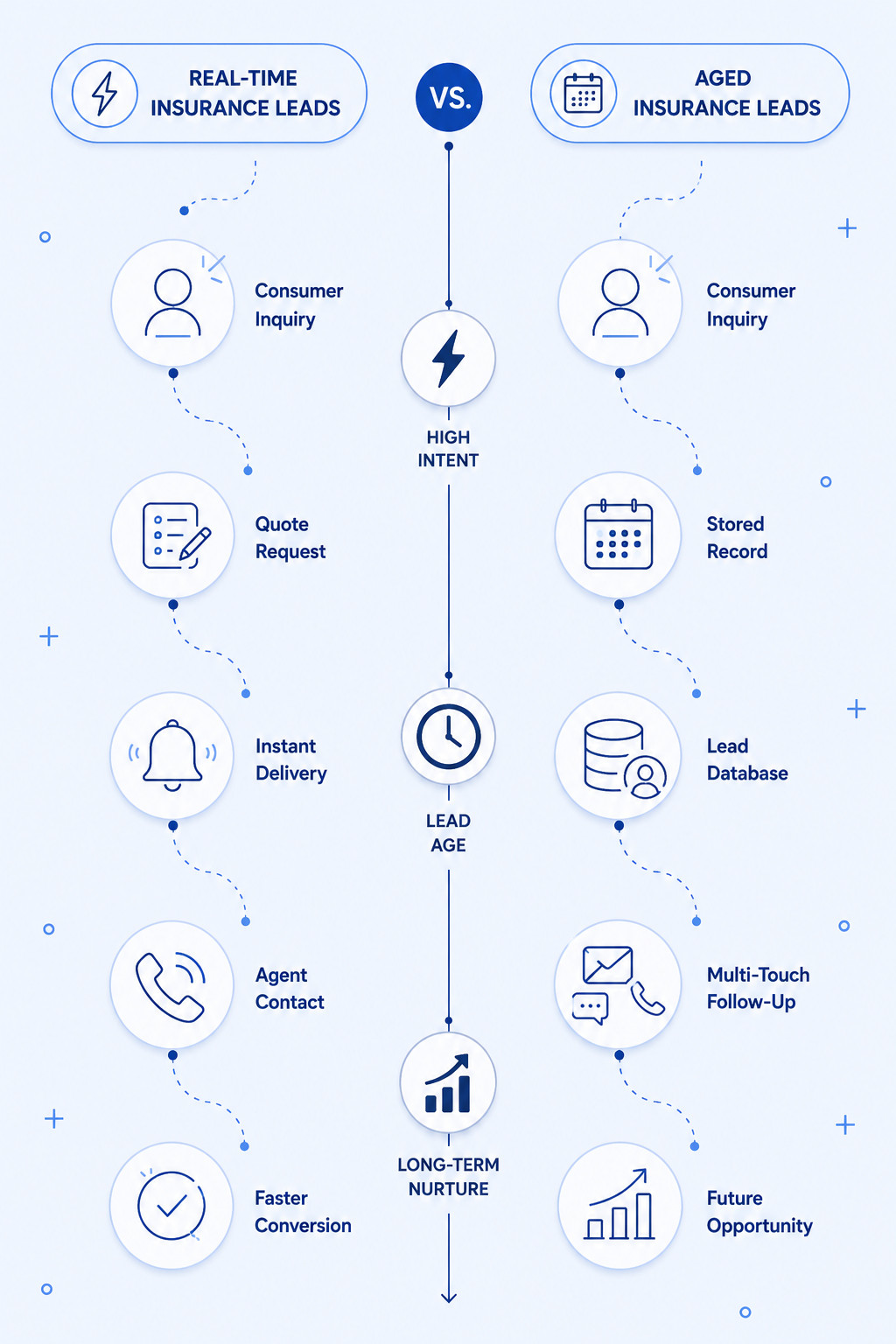
Real-Time vs. Aged Insurance Leads
Different insurance prospecting strategies require different balances between speed, volume, exclusivity, and budget. You might prioritize immediate outreach tied to active shopping windows or aged records to support lower-cost, long-term follow-up campaigns.
Real-Time Insurance Leads
Real-time insurance leads are delivered shortly after a consumer submits a quote request or insurance inquiry. This allows you to contact these prospects while they’re actively comparing providers and evaluating their policy options.
Real-time delivery is especially common in competitive verticals such as auto insurance, Medicare, and health insurance, where consumers often request several quotes within a short timeframe.
Aged Insurance Leads
Aged insurance leads are older inquiry records used in lower-cost, higher-volume prospecting campaigns. Although they’re less connected to immediate shopping behavior than real-time leads, many agencies use aged records to maintain broader pipeline coverage through multi-touch outreach strategies.
Aged auto insurance leads are among the most widely used categories for volume prospecting. In contrast, aged life insurance leads are often effective in long-term nurture campaigns, in which consumers revisit their coverage decisions over time.
Matching Lead Type to Your Sales Process
What Are Aged Leads and How Are They Different from Real-Time?
Aged insurance leads are older consumer inquiry records originally generated through quote requests or insurance comparison activity that weren’t immediately purchased or followed up on. These records are typically less expensive than real-time leads and are commonly used in higher-volume prospecting strategies.
Unlike real-time insurance leads, which are closely tied to immediate shopping behavior, aged records often perform best in structured multi-touch campaigns that combine phone, email, and ongoing follow-up.
Aged Auto Insurance Leads
Aged Life Insurance Leads
Aged life insurance leads are frequently used by agencies seeking consistent prospect volume while maintaining lower acquisition costs. Because life insurance decisions may be revisited later, long-term follow-up can continue generating engagement beyond the original inquiry window.
How to Convert Aged Leads with the Right Follow-Up Cadence
Aged insurance leads usually require a slower, more relationship-focused outreach approach than real-time records. Since the consumer may no longer be actively requesting quotes, outreach is most effective when it reintroduces relevance rather than assuming immediate purchase intent.
Many agencies use coordinated phone, email, and text follow-up over several days or weeks to maintain visibility without depending on a single contact attempt.
Comparing Insurance Delivery Methods
Different prospecting systems rely on different delivery methods depending on outreach style, staffing structure, budget, and sales workflow.

Real-Time Internet Leads
Real-time insurance leads are delivered shortly after a consumer submits a quote request or insurance inquiry. Because these records are closely tied to recent shopping activity, fast-response systems and structured follow-up play major roles in performance.
How Real-Time Leads Are Generated and Verified
Real-time insurance leads are commonly generated through quote comparison platforms, search advertising campaigns, carrier marketing programs, and insurance landing pages where consumers actively request pricing information. Before delivery, records may undergo duplicate suppression, contact validation, and consent screening to improve the quality of outreach.

Live Transfer Insurance Leads
Live transfer insurance leads connect agents directly with consumers who have already agreed to speak with an insurance representative. Because the conversation begins immediately, live transfers reduce delays associated with traditional outbound prospecting. This format is often used in higher-value insurance categories where phone-based sales conversations play a central role in conversion.

Telemarketing Insurance Leads
Telemarketing insurance leads are generated through outbound phone campaigns in which consumers engage directly with a representative before being delivered to an agency. Basic qualification information, such as policy interest, geography, and contact details, may be verified during the initial interaction, thereby improving outreach relevance.

Direct Mail Insurance Leads
Direct mail insurance leads are generated through targeted postal campaigns sent directly to consumers. Prospects who respond through return cards, phone calls, or landing pages have already engaged with the offer before agent outreach begins.
Direct mail remains especially effective in the Medicare Supplement and final expense markets, where older consumers often respond more consistently to physical mail.
When Direct Mail Outperforms Digital for Final Expense and Senior Markets
Senior insurance audiences are more consistently engaged by physical mail than by digital advertising alone. Many Medicare Supplement and final expense campaigns continue to rely heavily on direct mail paired with phone-based follow-up and appointment setting.

Multi-Channel Outreach Performs Better Than Single-Channel Prospecting
Consumers respond differently across phone, email, text, and direct mail. Agencies relying entirely on one communication method may miss opportunities to reconnect with prospects who engage through alternative channels.
Combining multiple touchpoints within the same campaign helps reinforce visibility while supporting more flexible consumer engagement.
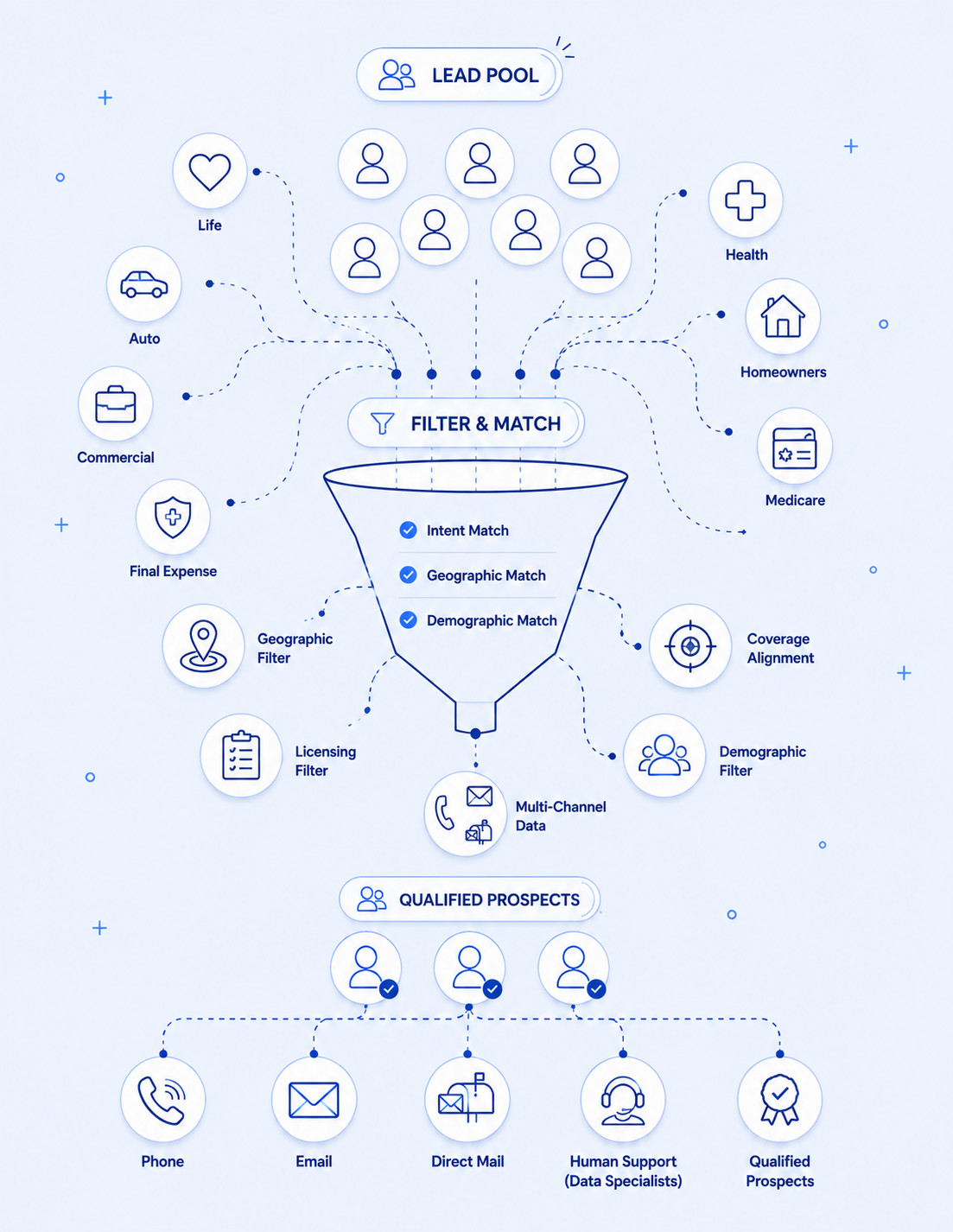
How Jared's Leads Filters for Intent & Reduces Wasted Outreach
Insurance prospecting becomes less efficient when campaigns rely on broad, untargeted lead feeds rather than on actual consumer intent and geographic alignment.
Jared’s Leads focuses on helping you reduce wasted dialing activity while improving your campaign relevance across:
- Life
- Health
- Auto
- Homeowners
- Commercial
- Medicare
- Final expense
Rather than emphasizing lead volume alone, the platform prioritizes filtering precision, geographic targeting, outreach coordination, and practical human support. With more than 25 years of experience and an A+ BBB rating, Jared’s Leads is an Inc. 5000 company that supports agencies seeking more controlled prospect targeting rather than broad mass-market distribution.
Geographic & State Licensing Filters
Your insurance agency can only market products within territories where you’re licensed and properly appointed. Geographic filtering by state, ZIP code radius, metro area, or custom territory helps you focus outreach on consumers you can actively serve. Localized targeting also helps reduce wasted outreach tied to unsupported markets or unavailable policy categories.
Carrier Appointment and Coverage Alignment
Not every carrier operates within every market or risk category. Aligning outreach with carrier appointments and available coverage helps you prioritize prospects you can realistically quote and service.
Intent and Coverage Alignment
Consumers shopping for auto, Medicare, life, homeowners, and commercial insurance all enter the buying process with different priorities and timelines. More refined filtering helps you align outreach with the insurance categories and consumer profiles most relevant to your products and sales workflow.
Demographic & Behavioral Targeting
Insurance outreach generally performs better when demographic filters align closely with the product being marketed. For example, term life campaigns often focus on consumers ages 30 to 55, while final expense outreach typically targets consumers ages 55 to 75.
Homeowner Status, Income Band, and Age-Range Filters
Homeowner status is commonly used in home insurance campaigns and in targeting home-equity-linked life insurance. Income band filtering helps agencies align offers with likely premium affordability, while age-range targeting supports product alignment across life, Medicare, homeowners, and final expense categories.
Multi-Channel Activation: Email + Phone + Direct Mail in One List
Many insurance lead providers offer only a single contact method. Jared’s Leads supports multi-channel outreach by providing records that may include phone numbers, email addresses, and postal mailing data within the same audience set. This approach allows you to coordinate your communication across multiple channels rather than relying entirely on a single outreach method.
Why Single-Channel Outreach Leaves Conversion on the Table
Consumers engage differently across phone, email, and direct mail, and some prospects ignore calls but respond later to email or physical mail. Using multiple communication channels helps you maintain visibility throughout the insurance shopping process.
Human Support for Targeting Setup
Insurance targeting requirements are often more nuanced than self-serve systems allow. Jared’s Leads provides direct human support from real team members for campaigns involving layered targeting, specialized insurance categories, or multi-state territory requirements. You can work directly with a data specialist to refine your audience selection and build campaigns aligned with your operational goals.
Designed to Reduce Irrelevant Outreach
Multi-Channel Insurance Prospect Outreach
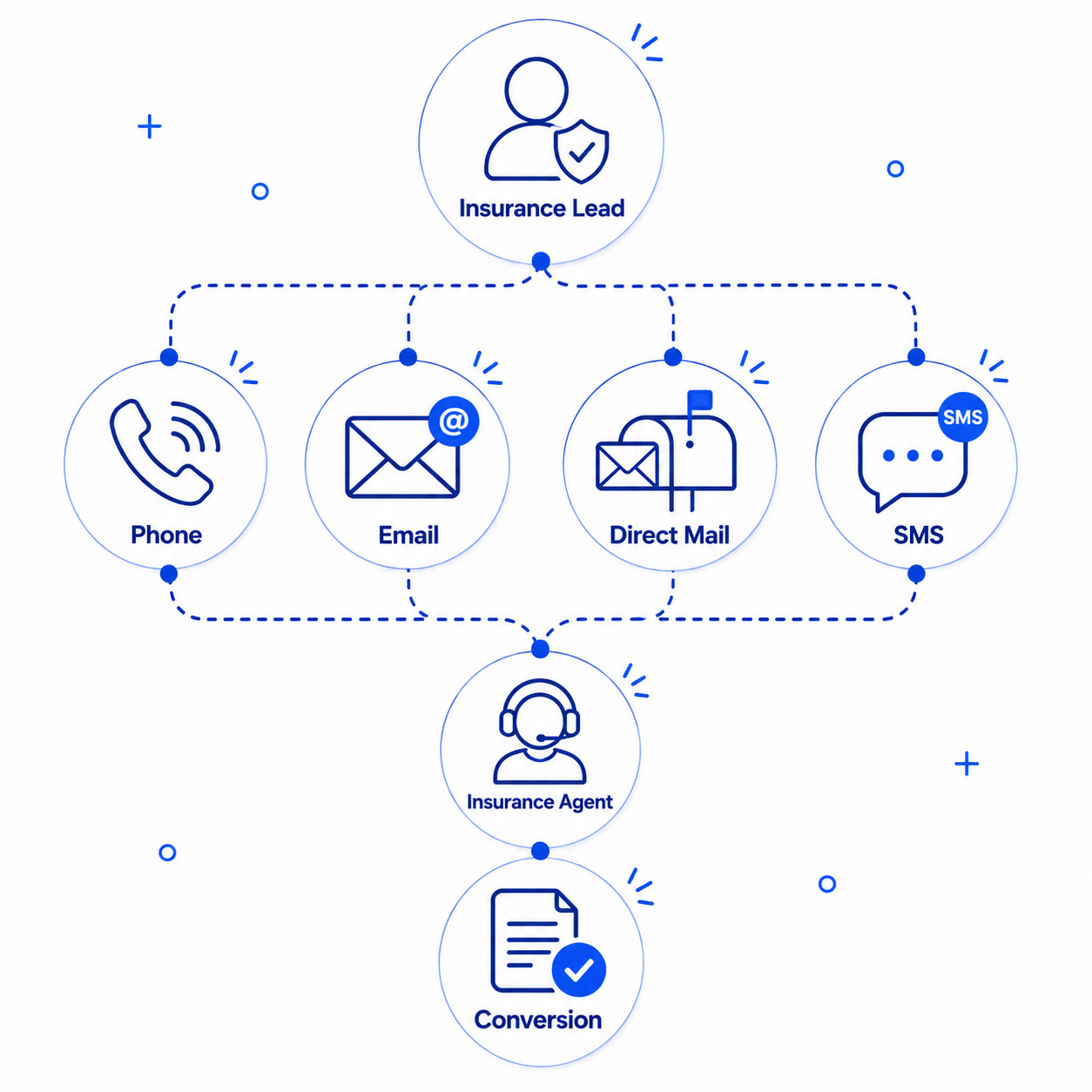
Insurance consumers don’t all respond through the same channel or at the same pace. Coordinating outreach across phone, email, and direct mail helps agencies maintain visibility throughout the shopping process. The payoff is measurable: agents who use three or more lead-generation channels earn an average of 47% more commission annually than single-channel agents.[3]
Coordinated Outreach Across Phone, Email & Direct Mail
Different communication channels serve different roles within the insurance buying journey. Some consumers respond immediately to calls, while others engage later through email or direct mail reminders tied to ongoing policy research. Using coordinated outreach across multiple channels helps you maintain visibility without relying solely on repetitive cold-calling.
Why Single-Channel Outreach Often Underperforms
Different consumers respond at different stages of the buying process and through different communication methods. Coordinated outreach across phone, email, and direct mail helps you maintain more effective engagement visibility.
Insurance Leads Pricing: What Affects Cost Per Lead?
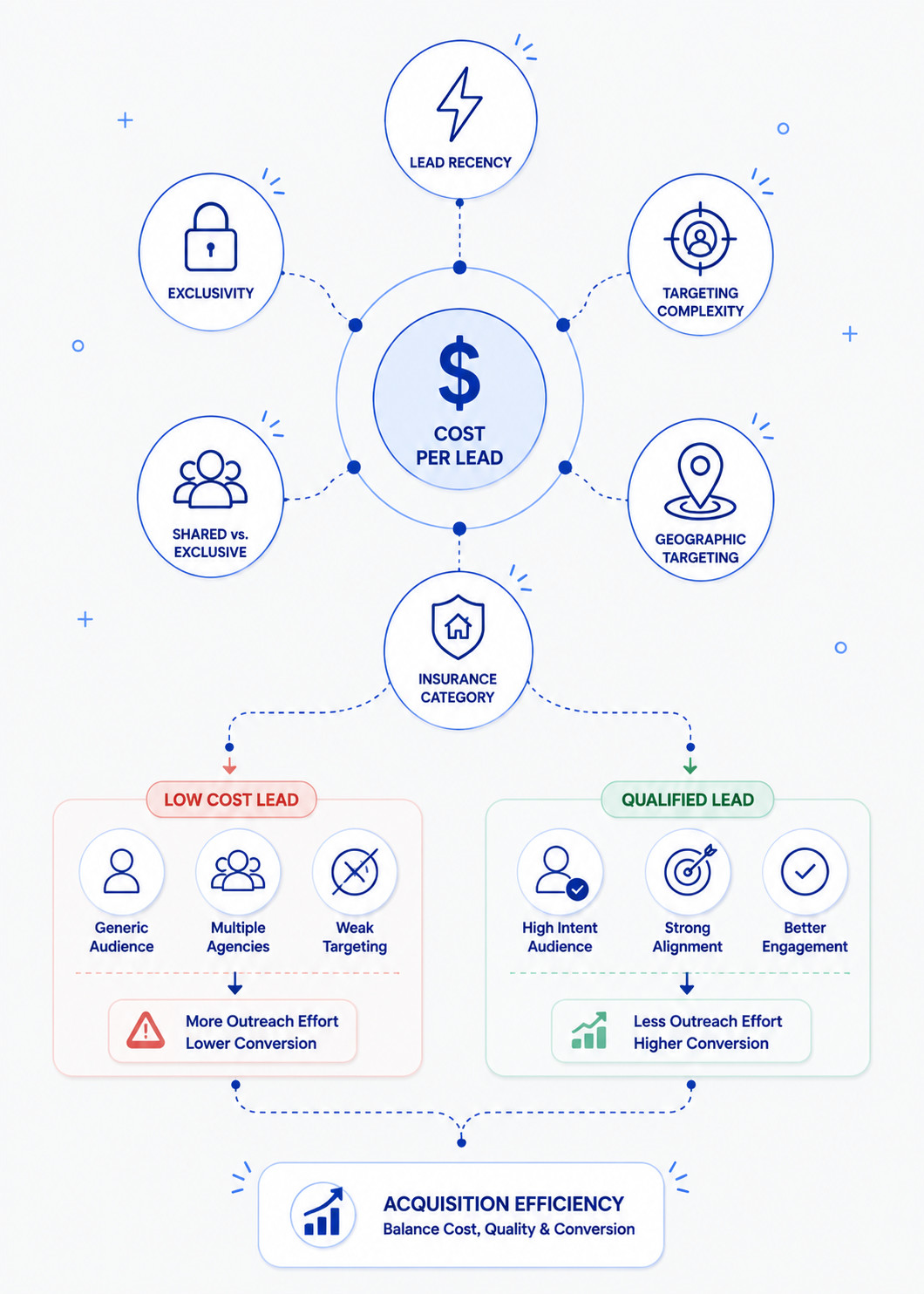
Insurance lead pricing varies based on:
- Exclusivity
- Lead recency
- Delivery method
- Targeting complexity
- Insurance category
- Overall market competition
Agencies evaluating insurance lead costs typically balance budget, staffing capacity, response time, and long-term policy value rather than comparing lead prices alone.
What Impacts Insurance Lead Pricing?
Insurance lead pricing is influenced by several variables, including exclusivity level, delivery speed, insurance category, geographic targeting, and filtering depth.
Real-time, exclusive records generally cost more because they’re more closely tied to active shopping behavior and less competitive. Pricing also varies significantly across verticals, including auto, life, Medicare, homeowners, and commercial insurance.
Shared vs. Exclusive Lead Pricing
Shared insurance leads are priced lower because the same record may be distributed to multiple agencies. Exclusive leads cost more because they are delivered to only your agency. The right strategy depends on your outreach speed, staffing capacity, policy value, and campaign goals.
Real-Time vs. Aged Lead Pricing
Real-time insurance leads typically incur higher acquisition costs because they’re more closely tied to immediate shopping activity. Aged insurance records are generally less expensive and commonly used within higher-volume prospecting systems. Many agencies combine both approaches depending on budget, staffing, and sales process requirements.
Why Lower-Cost Leads Often Produce Higher Acquisition Costs
Lower-cost insurance leads may initially appear attractive, but weak filtering, oversaturation, poor intent alignment, and low engagement can increase the outreach required to generate policy conversations. For many agencies, acquisition efficiency depends less on the lowest lead price than on whether the audience aligns with their products, geography, staffing capacity, and underwriting focus.
Ready to Build Your List?
Start reaching your ideal customers today. No minimums, no contracts.
[FAQs]
Insurance Leads FAQs
Have a question about Jared’s Leads and our lists? Let us help!
Insurance leads are verified contact records of consumers who have expressed interest in purchasing a specific insurance product, such as life, health, auto, homeowners, or commercial coverage. They allow agents and brokers to reach pre-qualified prospects rather than cold audiences, improving contact rates and reducing the time spent on consumers who are not actively in the market. Lead quality depends on source recency, filtering precision, and exclusivity level.
Yes, exclusive insurance leads are sold to only one agent, eliminating head-to-head competition at the point of first contact. For high-commission products like whole life, commercial insurance, and Medicare Supplement, the higher close rate from exclusive leads consistently produces a lower cost-per-issued-policy than shared leads, even at higher per-lead pricing. The math depends on commission structure, close rate, and response speed.
Real-time insurance leads are delivered shortly after a consumer submits a quote request, while aged leads are older records sold at a lower cost per lead. Real-time leads generally convert faster when contacted quickly, while aged leads often require multi-touch follow-up strategies but provide greater prospect volume at a lower acquisition cost. Many agencies use a blended approach.
Yes, insurance leads can typically be filtered by geography, insurance vertical, age range, homeowner status, income band, and other demographic variables. Geographic filtering helps agencies stay aligned with licensing requirements, while vertical filtering improves relevance by matching records to the products the agency actively sells.
Request Your Custom Insurance Lead List
Step 1: Choose Your Insurance Vertical
Select the insurance category you want to target, including life, health, auto, homeowners, commercial, Medicare, or final expense, and define your geographic territory by state, metro area, or ZIP code radius. If your campaign involves multi-state coverage or more advanced territory requirements, a data specialist can help refine your targeting before you order.
Select Your Filters, Exclusivity Level & Delivery Method
Choose your preferred targeting criteria, including geography, demographics, exclusivity level, delivery method, and consumer intent signals. You can select shared or exclusive records based on budget and conversion priorities, and choose from real-time, aged, live transfer, telemarketing, or direct mail delivery formats.
Receive Your Lead Count & Recommendations
A data specialist can review your targeting setup and help refine your campaign criteria before delivery. Records are provided in spreadsheet-ready formats compatible with most CRM systems, dialers, and email marketing platforms.
For direct mail campaigns, records are NCOA-processed and CASS-certified to support postal deliverability standards. Real-time leads generally perform best when contacted within 24 to 48 hours of delivery.
Good. We’re ready to make it work.
Jared’s Leads offers targeted business contacts based on the custom criteria important to your business. You’ll get verified, quality-focused data and support for sales and marketing campaigns.